

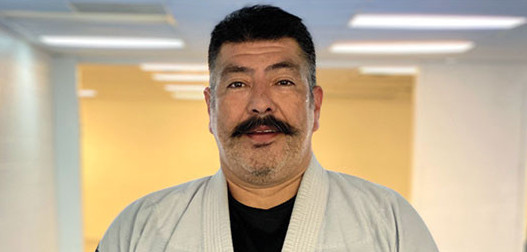
December 2016
I was living in Midland, Texas, working in gas and oil. I grew up in a small town in West Texas, went to Texas Tech University for mechanical engineering. After college, I worked in Lubbock, Texas, in New Orleans, in Houston and in Angola, Africa. I like to travel, meet new people, learn different cultures.
I started training in Brazilian jujitsu in 2002, right after college. I decided to set a new goal for myself: to run a half-marathon in San Antonio in early December. Everything went well. My time was good. I was very proud of myself.
January–March 2017
I rested over the holiday. But about a month later, I couldn’t catch my breath at times. I was like, I’m just out of shape. I’d been eating a lot over the holidays. But it got progressively worse. I went to my primary care doctor, who took X-rays. He saw something in my lungs but couldn’t pinpoint what it was. Neither could a lung specialist, who sent me to have a lung biopsy.
April 2017
I had surgery at Midland Memorial Hospital. After surgery, my surgeon came in with an oncologist and a gastroenterologist. The oncologist told me they found adenocarcinoma in my lungs, but it’s not lung cancer. It’s coming from my pancreas or stomach. They found an ulcerous area in my stomach, which they biopsied.
Stomach cancer had metastasized to my lungs: Stage IV. I went numb. I stayed in the hospital a few more days, doing breathing exercises, which were painful. Because it had spread, surgically removing the stomach wasn’t an option. The treatment would be palliative. I thought I was going to die. I didn’t realize that palliative wasn’t the same thing as end of life; it just meant they would treat it but wouldn’t try to cure it.
There was a saving grace: My cancer was HER2 positive. That’s a biomarker on the cells, an overexpression of a protein that makes cancer cells more aggressive. A targeted therapy can block that protein and starve cancer cells. My oncologist recommended a combo of three chemo drugs called FOLFOX plus the targeted therapy.
He’s a general oncologist, not a specialist, and he told me, “If you want a second opinion, go for it.” I called the University of Texas MD Anderson Cancer Center in Houston, eight hours away, and made an appointment with a gastric cancer specialist.
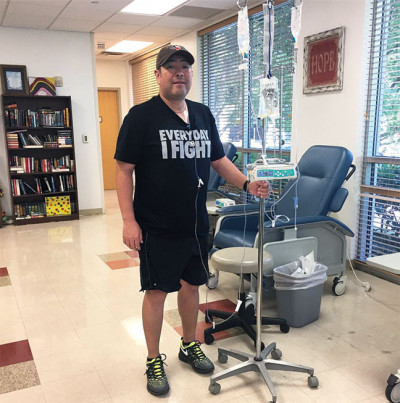
Javier FlorezCourtesy of Javier Florez
May–July 2017
At MD Anderson, they said the same thing: palliative care. Same regimen. I decided to have it done in Midland, 10 minutes away. I asked him, “What caused this?” There was no cancer in my family, and I hadn’t had stomach problems, just some heartburn. His answer was telling: “Bad luck.”
I started infusion treatment at Midland in late May, every two weeks. I was in the infusion center for five or six hours and then went home with a little pump connected to my port for two days. Then I’d go in and get the pump flushed out, and that was it until the next one.
I took short-term disability leave. That was bleak—May, June and July. It did drain me. For a couple of days after the infusion, I was just sluggish, weak. I took anti-nausea and anti-diarrhea medicine. But that only lasted a couple of days, so after that I was able to eat pretty much whatever I wanted.
One of the chemo drugs made me really sensitive to cold in my extremities, like fingers, nose, toes. It also made things taste metallic. At the infusion, I would drink room temperature water, but one day, I took a sip of cold water. Big mistake. I had pins and needles from my tongue all the way to my esophagus. To this day, I can’t withstand as much cold on my fingers as before. But I always tried to stay positive.
August 2017
At three months, CT scans showed my lungs were almost entirely cleared up. The stuff in my stomach was shrinking too. Bottom line: It was working.
But it was a battle. My parents were always there to support me, and I maintained constant communication with my two brothers. Another thing that really helped was a book by an ESPN sportscaster, Stuart Scott, Every Day I Fight. Just knowing that other people have gone through this helped.
December 2017
Around the sixth or seventh month, another scan. My lungs had already cleared, and now, nothing was visible in my stomach. So we stopped the chemo drugs and continued with the targeted therapy, an infusion every two weeks, about a half hour after getting hooked up to the machine. The main side effect is that it can affect your heart, so I get an echocardiogram every three months.
March–September 2018
I went back to work—80 hours over nine days with every other Friday off, when I‘d get my infusion. Unfortunately, I was looked at a little bit different because of my diagnosis and having been out. I’m good at my job, but my career was kind of capped.
I went for walks to recover my endurance. I had gained weight. There’s something about walking outside, especially here in West Texas in this dry air. I went to the gym, did some weights but mostly the treadmill. I started going back to jujitsu. Everybody at the gym knew my situation. It’s not like they took it easy on me, but they didn’t kill me. Eventually, I was walking about three miles a day too.
2020
In July, with COVID, there was a restructuring going on at work, so I took it. I wanted to mainly focus on my health. Even though I’m doing well, it does take a toll on you. I feel like I live from scan to scan. In November, I got a high school teaching certificate.
August 2021
I started teaching sixth grade math and science. By November 2023, though, I semiretired. I had saved up quite a bit from my job, and not being married and having no kids helps. I live a pretty simple life.
2022–2023
I started conversing with stomach cancer support groups on Facebook. They were involved in an organization called Hope For Stomach Cancer. They knew Aki Smith, the founder. Next thing I knew, she contacted me. I started talking with her and reading up. They have so many resources and such community. In November 2023, Smith invited me to the first Hope For Stomach Cancer Patient Empowerment Summit, in Long Beach, California. Meeting face-to-face is really a connection. I share my story to see if it’ll give someone hope.
April 2026
It’s now nine years for me. I still get an infusion every two weeks and an echocardiogram every three months. So far, my heart is fine. Finding Hope For Stomach Cancer has been a godsend. My first treatment is still working, so I haven’t had to deal with options, but now, I know what’s coming up next, what clinical trials there are. And that community! You’re not going through it alone.
I’ve gotten to know the infusion nurses and always joke with them. I think a positive mind really translates to your body reacting more positively to treatments. Knock on wood, I’m doing well. My scans are annual now instead of every six months.
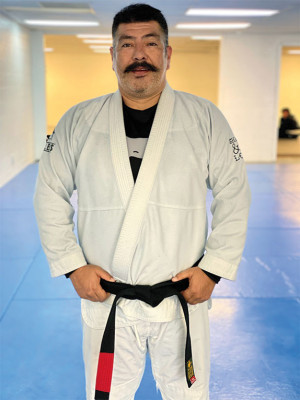
Javier FlorezCourtesy of Javier Florez
I’m teaching jujitsu, two nights a week. I still do a lot of walking with my two dogs, a Chihuahua and an Australian shepherd/dachshund mix. They’re both awesome. I’m doing advocacy with Hope For Stomach Cancer and looking to volunteer with a local cancer support group. And I’m focused on helping my parents—my dad has Parkinson’s. I’ll go over there every day and see if they need anything. It’s almost like returning the favor.




Comments
Comments