

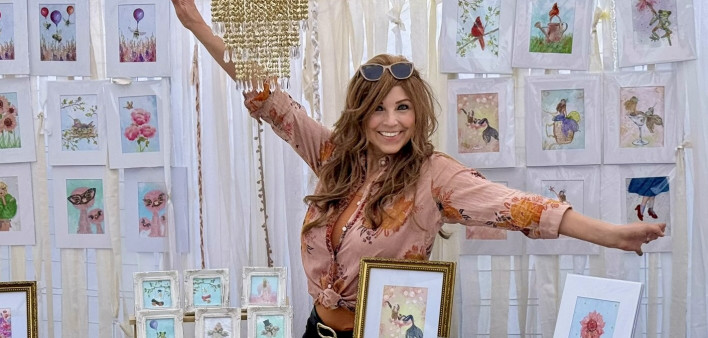
When she was 15, Jacquie Angell was diagnosed with non-Hodgkin lymphoma, a type of blood cancer. In 2013, she developed HER2-positive breast cancer in her left breast. After a mastectomy, her body rejected the breast implant reconstruction, so she had flap reconstruction surgery while continuing treatment. But just a month after she celebrated becoming cancer-free in 2020, she found a lump in her right breast. This time, it was triple-negative breast cancer. She underwent a lumpectomy, chemotherapy, radiation and immunotherapy. Eventually, it progressed to Stage IV, spreading to her liver and lungs. She also has a pacemaker-defibrillator due to heart damage. She’s currently undergoing chemotherapy.
That’s a lot of experience with cancer, yet illness hasn’t held her back. As an international speaker and corporate trainer, Angell traveled the globe. Now 59, she lives in Thousand Oaks, California, with her husband, Marc, 68. They have two adult children, Alexandria and Anthony, and “two very opinionated cats,” Mr. Boots and Trixie.
“Cancer has changed many things about my life, but it hasn’t changed who I am,” she says. “I’m still the same optimistic, determined person I’ve always been. I’ve simply had to learn to navigate life a little differently, and along the way, I’ve discovered that sometimes life’s biggest detours lead to the most meaningful destinations.”
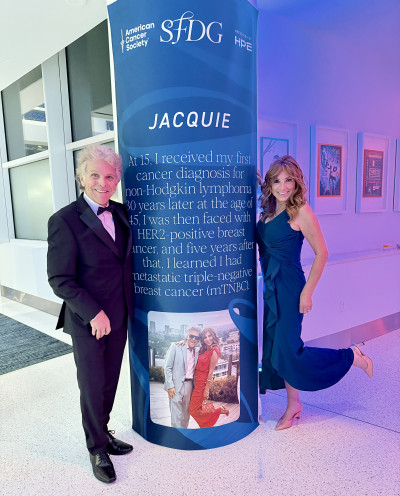
Marc and Jacquie Angell at an American Cancer Society galaCourtesy of Jacquie and Marc Angell
For example, as a way to focus on something other than scans, appointments and health updates, Angell and her 83-year-old mother began creating whimsical hand-embellished art. Soon, the fun pastime developed into the business Sparkles & Splatters.
We spoke with Angell for the latest installment of our Can Heal column—that empowering phrase is right there in our title, Cancer Health. The column discusses the myriad nonmedical strategies and insights that help many folks with cancer. Our interview has been edited for length and clarity.
How has your attitude toward cancer changed over the decades?
Sometimes, I joke that I’ve become a professional cancer patient. When I was diagnosed with non-Hodgkin lymphoma, my prognosis was poor, and for a long time, I assumed I wouldn’t have the opportunity to grow up, build a career or have a family.
But after college, something shifted. I realized that maybe I didn’t have an expiration date after all. Instead of living under the shadow of cancer, I decided to truly live.
People often ask how I keep going. The truth is, I don’t spend much time wondering, Why me? I simply ask, What’s next? Some days, it just makes me giggle to myself. I’ve learned that living with metastatic cancer isn’t about pretending life is easy. It’s about adapting, making the best decisions you can and continuing to find reasons to live fully despite the uncertainty. And I love being able to change my hair color and style on a daily basis—it keeps life exciting.
One lesson I am passionate about sharing is the importance of knowing your own body. I discovered both of my breast cancers myself. One was found just weeks after a normal mammogram, likely because I have extremely dense breast tissue. Those experiences made me a strong advocate for self-awareness and breast self-exams. Screening is incredibly important, but no one knows your body better than you do. Never ignore something that doesn’t feel right simply because a test came back normal.
What has helped you deal with and accept the diagnosis?
Without question, the greatest source of strength and support throughout my breast cancer journey has been my husband, Marc. Although he jokingly refers to himself as my caregiver (a title I still refuse to give him), I prefer to call him my husband. To me, that’s much more meaningful and a lot less cringey. He is my husband, after all, and “caregiver” just doesn’t sound very romantic.
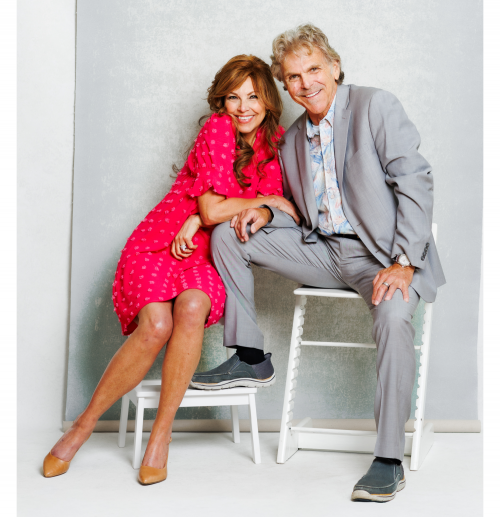
Jacquie and Marc Angell share their stories through Side by Side: Two Perspectives. One Journey, a presentation they take to conferences and other events.Courtesy of Jacquie and Marc Angell/Gina Main Photography
Marc has never missed a single doctor’s appointment, chemotherapy treatment or even a routine blood test since we began this adventure more than a decade ago. More importantly, he has never let cancer define our relationship. He still makes me laugh, encourages me to dream and reminds me that I’m so much more than a diagnosis. And when I stopped chemo for a while when I was having surgery, he gave me the mohawk hairstyle I always wanted. He even dyed it pink for me. LOL. He truly is my “Angell” in every sense of the word.
My parents have also been an incredible source of love and support. They pulled me through my battle with non-Hodgkin lymphoma when I was a teenager, and now, decades later, they continue to walk this road with me.
I have also been incredibly fortunate to have an oncology team that feels like family, especially my nurses. There was a time when I dreaded going in for treatment. I knew I needed to change my mindset, so I came up with a little mission. I started hiding tiny resin ducks throughout the oncology center.
Even in the middle of cancer, there’s always room for laughter and silliness. In fact, there’s no better time.
At first, no one knew where they were coming from, and I certainly wasn’t telling. Then Marc got involved, which made the mystery even more entertaining because ducks kept appearing while I was in treatment.
Eventually, they figured out who “the Duck Lady” was, but that didn’t stop the fun. Years later, we’re still hiding ducks, and they still look forward to finding them. Those little ducks changed something for me. Instead of walking into treatment focused on chemotherapy, I walked in excited to make someone smile. It reminded me that even in the middle of cancer, there’s always room for laughter and a whole lot of silliness. In fact, there’s no better time.
Similarly, what has helped you stay healthy (not counting treatments and meds)?
Like most people living with cancer, I try to do all the things we’re “supposed” to do. I eat a fairly healthy diet, try to load up on fruits and vegetables, and I’ve cut back on sugar wherever I can. But I’m not perfect, and I don’t think perfection is what has carried me through this journey.
What has helped me the most is, I discovered that if cancer is the only thing you talk about, before long it’s the only thing you think about. I needed something else to talk about.
There was a time when my mom would call or text me every afternoon to check on me. It always came from a place of love, but the conversation was usually the same: “How’s your headache? Your stomach? Your nausea?” Before long, I realized I was actually dreading those calls—not because of my mom but because I was tired of cancer being the center of every conversation.
Around that same time, I started painting late at night when I couldn’t sleep. Watercolors became my escape. I would send my artwork to my mom, and she immediately fell in love with it. Before long, she started hand-embellishing each piece with diamond dust, glitter and sometimes Swarovski crystals to make them sparkle even more.
Without even realizing it, everything changed.
So instead of talking about chemotherapy, we were talking about colors. Instead of discussing side effects, we were debating picture frames, glitter, greeting cards, ornaments and new ideas.
We didn’t stop fighting cancer.
We simply stopped allowing it to be the center of every conversation.
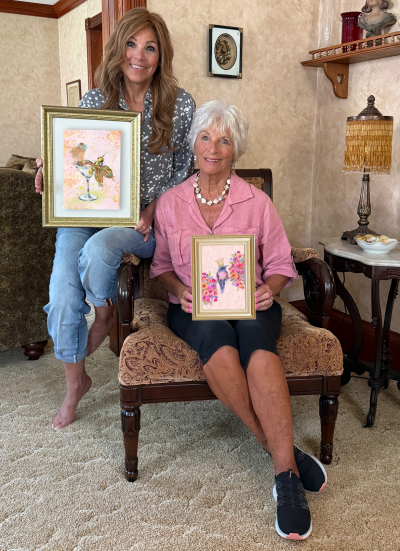
Jacquie Angell and her mom, Gail Carter, collaborate on their artwork.Courtesy of Jacquie and Marc Angell
That little creative outlet eventually grew into our family business, Sparkles & Splatters. Today, it’s become a true family affair. We create whimsical art together, travel to art shows, meet incredible people and even built a website to share our creations with others. If you ever get the chance to work alongside your 83-year-old mom, I highly recommend it. It’s a total scream, and we’ve had more laughs than I can count.
Can you tell us more about the artwork and its effect on you?
People often ask if our artwork is about cancer, and in some ways, it is. Not because we paint cancer but because we paint everything cancer isn’t. Cancer has taken a lot from me, but it hasn’t taken away my imagination. That’s what you’ll find in every piece we create.
Cancer can consume your thoughts if you let it. Our artwork is colorful, playful, hopeful and just a little over the top because that’s exactly how we wanted to feel. Every piece is designed to make someone smile, laugh or simply forget about life’s challenges for a few moments.
A creative outlet or a passion project can remind you that you’re still you.
One of the greatest gifts this journey has given me is discovering that creativity has no age limit. My mom is in her 80s, and together we’ve built something neither of us ever imagined. We laugh constantly, bounce ideas off one another, travel to art shows and celebrate every little success together. Those memories are every bit as meaningful as the artwork itself.
If there’s one thing I hope people take away, it’s that difficult circumstances don’t have to define your life. Whether it’s painting, gardening, baking, photography, woodworking or something completely different, finding a creative outlet or a passion project can remind you that you’re still you.
Our artwork isn’t about escaping reality. It’s about making sure joy still has a place in it.
What advice would you offer for people newly diagnosed with cancer?
My first piece of advice would be: Don’t ask everyone for advice. (I say that a little tongue in cheek.) The moment people hear you have cancer, everyone has an opinion. It can become overwhelming very quickly. Cancer is not a cookie-cutter disease. Advice that works beautifully for one person may be completely wrong for someone else.
I’ve learned to take what works for me and leave the rest. That’s really what the slogan “just be you” means. Find the path that fits your life, your values and your body, not someone else’s.
My second piece of advice is to be careful where you get your information. Not every article or social media post is helpful. Find reputable sources and lean on your medical team. While online support groups can be wonderful for some people, they can also be frightening because people naturally share their most difficult experiences. Remember, a listed side effect doesn’t mean you’ll have it. And even if you do, everyone’s experience is different. Be informed, be prepared, but don’t assume the worst.
If you’re feeling anxious about starting treatment, know that it’s completely normal. I was too. But I also tried to remind myself that treatment wasn’t the enemy—it was an opportunity. It was something that might help me live longer, feel better or give me more time with the people I love. Looking at it that way helped me walk into treatment with a little more hope than fear.
Finally, ignore statistics. We are not statistics; we are human beings. Statistics don’t measure our faith, our resilience, our determination, our support systems or our will to keep living. Several years ago, I was told I had 90 days to live. It’s kind of funny when you think about it. Well, those 90 days came and went a long time ago. Ever since then, I’ve decided statistics are just numbers. They don’t get to tell my story. I do.
Any additional advice for those with Stage IV cancer like you?
First, if you’re going to wear a wig, and it’s within your budget, I recommend human hair. You can curl it, straighten it, style it and make it feel a little more like you. When so much feels out of your control, keeping a little bit of your own style can make a big difference.

Jacquie Angell, three time cancer survivor, launched Sparkles & Splatters to share her whimsical artwork.Courtesy of Jacquie and Mark Angell/Gina Main Photography
And here’s one of my favorite little tips. If your wig makes your scalp itchy, ask your medical team whether a numbing cream, like the kind often prescribed before accessing a port, is appropriate for you. A little on your scalp before putting your wig on can make it much more comfortable.
Beyond that, the biggest lesson I’ve learned is to keep living while you’re living.
To read Marc Angell’s wisdom for caregivers, read “His Wife Has Stage IV Cancer. Here’s His Advice for Those on Similar Journeys.”



Comments
Comments