

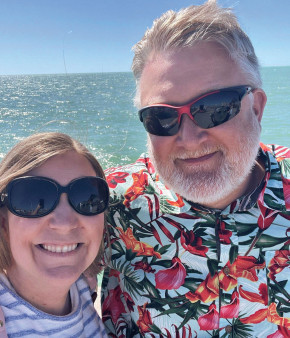
I’m an architect, and I live in Green Bay, Wisconsin, where I was born and raised.
One day at the office, I developed a dull pain in my right lower abdomen that grew in intensity. I checked into the emergency room. My gallbladder was infected and had to come out. When I was in the recovery room, they brought in the oncologist. Routine pre-op blood tests showed elevated white blood cells; further testing diagnosed me with chronic lymphocytic leukemia—CLL. I had a low-risk variety, so the accepted course was “watch and wait.”
I had proposed to my girlfriend a few months before. I guess I’m a late bloomer—I was 33. It was really nice to have that kind of relationship in place for moral support and everything. She was all worried, and my parents thought cancer was a death sentence. I was surprised, but I take an analytic approach. I did jokingly ask my girlfriend, “Does this change your answer on the engagement?” She was great. We’ve been married 21 years now and have three children.
2007
Through research and chat boards, my wife and I found a clinical trial using an experimental vaccine at MD Anderson Cancer Center in Houston. The trial was a failure, but I found two world-renowned experts in CLL. I learned a lot from them, including how to stay on top of research.
September 2013
My blood counts were trending poorly, and my spleen became enlarged. My MD Anderson oncologist and I selected a combo regimen—a monoclonal antibody and two chemotherapy drugs.
I didn’t stop working, just took some time off for treatments. I sat down with my supervisor, and he said, “We’ll just make it work.” I feel lucky to have that kind of support.
October 2013
I got chills the first time they infused the monoclonal antibody. They stopped for a while and then continued with no side effects. Later, I started taking the two chemo drugs. I felt a little rundown for a few days.
November 2013
I started the second round of treatment. A few days after that, I had an episode of atrial fibrillation, a known possible complication. I was held in the hospital for observation and got antibiotics.
My wife is the primary caregiver for the kids, so there wasn’t a big change in routine for them. When I had complications, though, she was giving me a lot of attention, and my oldest, who was 8, felt he wasn’t getting enough. We just reassured him, and he got through it pretty quickly. I missed Thanksgiving, but we made sure the kids didn’t miss anything.
December 2013
I got an X-ray due to congestion from a “cold.” Then a CT scan. There was an abnormal area in the left lung. It turned out my body wasn’t producing any immunoglobulins [antibodies]! I’ll need to get immunoglobulin infusions—IVIG— perhaps for the rest of my life. A week later, I felt great. Started treatment round 3. Recovery went great.
April 2014
It was take-out-the-port day. It occurred to me that this was the defined endpoint for my first treatment.
November–December 2015
Wow! I was living life like a normal person—nothing major going on with my health; dealing with typical ailments, like blood pressure, being overweight and having knees that make all kinds of noise!
May 2016
A regular checkup confirmed my worst fears—I was relapsing. Now I got to be anxious again, during another, presumably shorter, watch-and-wait period.
September 2016
I had a 17p deletion on 26% of the test cells, a marker indicating a more aggressive form of CLL. Turns out the chemo had killed off the easy stuff, allowing the hardier cancer cells to take over. My oncologist recommended a Phase III clinical trial at the Mayo Clinic comparing the effectiveness of an approved targeted therapy versus an experimental second-generation targeted therapy.
October–December 2016
I had my first consultation at the Mayo Clinic in Rochester, Minnesota. It was a four-hour drive—a lot closer than Houston! I considered those trips mini-vacations—I got to stay in a nice hotel and eat out while I was there. And I could work remotely and video call my family at night. I started taking my pills and had mild headaches. My white blood cells went down and platelets went up, so it was working. By December, the headaches abated.
January–June 2017
In April, my monthly visits to the Mayo Clinic stretched to quarterly. The new drugs seem to work even for those with the 17p deletion mutation.
January 2020
The experimental drug I was on was approved by the Food and Drug Administration. I’ll continue with it after the trial is over.
March 2020
The whole world literally shut down due to COVID-19. Mayo arranged for my next appointment to be virtual, and I started getting IVIG infusions at home.
March–August 2021
Well, I officially developed resistance to my treatment. The drug was still working, just not as effectively as before. At my regular Mayo appointment, we talked about options, including several drugs and CAR-T therapy, which is riskier, and a transplant. I planned to stay on my treatment in the trial as long as possible and then on commercial supply.
March 2022
I started a new protocol: two different targeted therapies. I was to take one for six months via infusion and another one as pills for two years. After my first infusion, I got chills and threw up. I wound up back in the hospital two days later. An abdominal scan showed low-grade bowel obstruction, likely caused by scar tissue from an earlier abdominal surgery. During all this, tests confirmed the therapy’s effectiveness.
April–August 2022
I restarted infusions, then pills. I weaned myself off earlier treatment.
May 2024
I came to the end of this treatment. I hadn’t shown resistance, so they could put me back on if needed.
November 2025
I’m back to watch and wait. I keep track of the research. I will probably eventually be in a CAR-T trial; while it has worked wonders for other types of cancer, its record with CLL is more measured. I do hope to get a normal lifespan.
My advice to someone diagnosed with this or, really, any cancer? Be your own advocate. Do your own research. Don’t just go to the clinic and do whatever they say. Instead, be an integral part of the care team. Find an expert in your particular cancer. And finally, lean on your family and friends. When they offer to help, accept it, even if it’s just making a lasagna or watching the kids.
When I get asked to fill out quality-of-life surveys at doctor’s offices, I’m like, I’m fine. CLL doesn’t impact how I’ve wanted to live. Cancer won’t get the best of me. As much as I’ve been through, I still consider myself very lucky.



Comments
Comments