

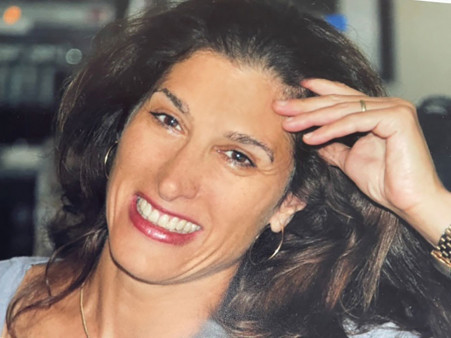
Emily Rubin had just finished working on her debut novel, Stalina, when she was diagnosed with breast cancer in 2008. She completed treatment in 2010, and the book—about a Russian immigrant who comes to the United States after the fall of the Soviet Union—was published to acclaim in 2011.
Also in 2011, she launched the Write Treatment Workshops for cancer patients, survivors and caregivers. Today, she runs six Zoom workshops a month for Mount Sinai New York City’s cancer centers and several four-week workshops and single workshops for the New York Oncology Hematology Community Cancer Foundation, which supports people in upstate New York; the workshops are funded by Poets & Writers, Mount Sinai Support Services and the New York Oncology Hematology Community Cancer Foundation.
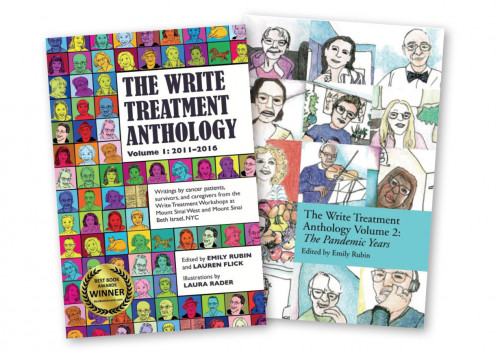
The Write Treatment Anthology, Volumes 1 and 2Courtesy of Emily Rubin
Many of the resulting works from the workshops have been compiled and published in The Write Treatment Anthology Volume 1: 2011–2016 and Volume 2: The Pandemic Years (book sales benefit the workshops, which are free to participants).
“I started the Write Treatment Workshops because I realized that cancer would always be a part of who I am,” Rubin says, “and through writing, I was able to address some of the anxiety and fear that comes from always wondering if I have to face having cancer again.”
We wanted to learn more about the curative effects of writing, so we reached out to Rubin, 68, who lives in Copake, in New York state’s Hudson Valley, for the latest installment of our Can Heal column—the empowering phrase “Can Heal” is right there in our title. Our interview has been edited for clarity and length.
First off, can you summarize your cancer journey and give us an update?
I had noticed a lump in my left breast that protruded enough to cast a shadow. One day, it was there! I went for a mammogram and ultrasound and a needle biopsy. Very quickly, I was diagnosed with Stage II breast cancer—not hormonal. The first course of treatment was surgery, which involved a lumpectomy and the removal of eight lymph nodes. This was followed by chemotherapy and then radiation. I am very vigilant about self-exams, mammograms and ultrasounds, so I recently had to have something suspicious tested by needle biopsy. Fortunately, it was negative. [Editor’s note: since this interview, Emily was diagnosed with triple negative breast cancer and has started treatment.]
You completed a novel before your diagnosis. Did your writing habit change during treatment?
During treatment, I did not write very much. I kept a journal and made entries that were short, sometimes just a word, a sentence or a sketch. I wrote in a notebook, rather than on the computer. I used the computer for the business of dealing with doctors and insurance. Writing by hand—the direct connection between my thoughts and the page—was very personal and intimate.
The range of thoughts was a roller coaster, but there were often moments of lightness and humor—always a help. I was often thinking about the seasons changing as I went through treatment. One entry was about being so happy when the red-winged blackbirds returned, signaling that winter was coming to an end. Having these thoughts recorded, as spotty as they were, along with photos, my wig and letters from well-wishers, I think, have influenced my writing, storytelling and teaching to this day. It was useful to see what I noticed each day and what I was curious to explore. Making those observations and collecting them has always been a part of my daily writing life.
Aside from your journal and your care team, what specific habit or item helped you heal along your journey?
One of the more frustrating times for me was going five days a week for radiation treatment. The hospital was down to only one radiation table, so the wait time for treatment was long. I would often get there at 6:30 a.m., when they first turned on the machines, so I could then get to work. I got some meditation CDs—sounds of the rainforest mixed with jingling bells, soothing deep and airy vocals, all edited into hourlong compositions. It was a bit woo-woo otherworldly, but I needed a break from the stress of all the waiting and getting through treatment. When I was done, I celebrated with friends!
Tell us more about your writing workshops.
When I first started, I brought prompts to inspire our writing time. Grunts, sighs, tears and laughter were heard in the room as we wrote. After the timed writing, everyone shared what they had written. Now, we’re meeting on Zoom. I hold two surprise prompt workshops every month. For the [separate] workshop I hold weekly, I send the participants writing prompts to be worked on before we meet. We spend some time catching up and offering support for anyone going through a difficult time with treatment or other life challenges. We all read our work and offer observational and supportive feedback. The prompts are rarely cancer-focused. Although people write about their cancer journeys, they more often write about childhood experiences, travel, relationships, etc. I encourage people to write fiction, poetry, plays and memoirs. All literary forms are welcome.
Going through cancer gives us many of the things it takes to be a good writer.
The goal of the workshops is to take the leap of faith to write a story with no worry about whether it is good or perfect. In fact, I embrace the messiness of a first draft. After that, I try to bring the writers through the process of rewriting. I make it clear that they have complete control. They are the author and, therefore, have complete authority. This is important for people going through treatment or in recovery. There were times when I felt that I had lost control of what was happening to my body. Writing was the time and place where I could take complete control. It’s about turning what’s inside outside and vice versa.
Do you think cancer can enhance one’s storytelling abilities?
I always tell new participants that going through cancer gives us many of the things it takes to be a good writer. You are vulnerable, faced with difficult choices, required to find empathy for yourself and others and must be strong in the face of difficult challenges, including thoughts about mortality. Listening to others’ stories is an act of empathy, and learning that is very important to the process. All these elements make for good writing.
Emily Rubin just completed her second novel, Solo Girl, based on her experiences as an urban homesteader renovating a building in New York City’s East Village during the 1980s. For more information about her workshops, email write.treat@gmail.com. Learn more about her work at EmilyRubin.net.




Comments
Comments