

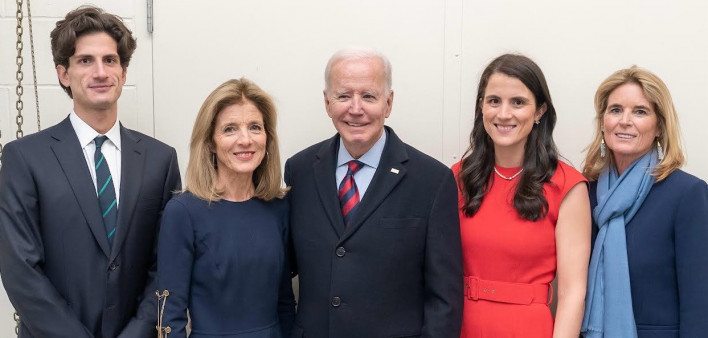
UPDATE: Tatiana Schlossberg, an environmental journalist and member of the famed Kennedy family, died December 30, 2025, at age 35, reports CNN. Just last month, she shared an essay in the New Yorker about being diagnosed with a terminal blood cancer in May 2024 shortly after giving birth to her daughter. See below for our reporting on that story.
Schlossberg was the daughter of former U.S. Ambassador Caroline Kennedy and designer Edwin Schlossberg, and the granddaughter of former President John F. Kennedy. She is survived by her husband, George Moran, 3-year-old son and 1-year-old daughter.
“Our beautiful Tatiana passed away this morning. She will always be in our hearts,” the family wrote in a statement. Signed “George, Edwin and Josephine Moran” and “Ed, Caroline, Jack, Rose and Rory,” the statement was posted on the account of the John F. Kennedy Presidential Library and Museum.
View this post on Instagram
Below is the original Cancer Health article dated November 26, 2025:
Tatiana Schlossberg, daughter of Caroline Kennedy and granddaughter of John F. Kennedy, announced that she has been diagnosed with a rare type of blood cancer that is terminal. While sharing her personal story, Schlossberg criticized her cousin Robert F. Kennedy Jr., the nation’s secretary of health, for his inexperience and detrimental impact on our health care system.
In an emotional essay published to The New Yorker on the anniversary of her grandfather’s assassination, Schlossberg, 35, reveals that she was diagnosed with acute myeloid leukemia (AML) after giving birth to her second child in May 2024.
“I did not—could not—believe that they were talking about me,” she wrote about receiving the diagnosis. “I had swum a mile in the pool the day before, nine months pregnant. I wasn’t sick. I didn’t feel sick. I was actually one of the healthiest people I know.”
View this post on Instagram
Leukemia refers to a group of cancers that affect blood-forming stem cells or immature blood cells, primarily white blood cells that carry out immune responses. Abnormal cells can grow out of control in the bone marrow and enter the bloodstream before they are fully developed, crowding out mature blood cells.
People with leukemia often have few or no symptoms during its early stages. Chronic leukemia may remain asymptomatic for years, while acute leukemia can progress rapidly, according to Cancer Health’s Leukemia Basics.
“During the latest clinical trial, my doctor told me that he could keep me alive for a year, maybe,” she wrote. “My first thought was that my kids, whose faces live permanently on the inside of my eyelids, wouldn’t remember me.”
Schlossberg has participated in clinical trials and undergone several treatments, including chemotherapy, immunotherapy and two bone marrow transplants. Her sister, Rose, turned out to be a match and donated stem cells.
In her essay, Schlossberg criticizes the detrimental impact her cousin, Robert F. Kennedy, Jr., has had on the health care system since being confirmed as the U.S. Secretary of Health and Human Services, including cutting billions of dollars in medical funding, including cancer research, and pushing anti-vaccine rhetoric.
“I watched from my hospital bed as Bobby, in the face of logic and common sense, was confirmed for the position, despite never having worked in medicine, public health, or the government,” she wrote. “Suddenly, the health care system on which I relied felt strained, shaky.”
About 22,010 people are estimated to be diagnosed with AML this year, accounting for about 1% of all new cancer cases, according to the National Cancer Institute. The five-year survival rate for AML is about 32%.
Schlossberg worries about funding for leukemia and bone marrow research and clinical trials at Memorial Sloan Kettering, where she received treatment. But oncology research across the nation is being affected by the upheavals and budget cuts in the federal health care system.
A recent report shows that over 74,000 people enrolled in medical studies and clinical trials have been impacted since RFK and the Trump administration terminated billions of dollars in grants to the National Institutes of Health in February.
To learn more, click #Acute Myeloid Leukemia or read Cancer Health’s Basics on Leukemia. It reads in part:
How is leukemia classified?
Leukemia is classified according to the type of cells affected, whether it is acute (fast-progressing) or chronic (slow-growing) and whether it affects adults or children. Acute anemia involves overgrowth of immature blood cell precursors, known as blasts, that cannot carry out normal functions. Chronic leukemia involves overproduction of more mature but abnormal blood cells that are only partially functional. There are four major types of leukemia:
- Acute lymphocytic or lymphoblastic leukemia (ALL)
- Chronic lymphocytic leukemia (CLL)
- Acute myeloid or myeloblastic leukemia (AML)
- Chronic myeloid or myelogenous leukemia (CML)
Acute lymphocytic leukemia involves overgrowth of precursors known as lymphoblasts in the bone marrow, which give rise to lymphocytes (B cells, T cell and natural killer cells). Chronic lymphocytic leukemia usually involves overproduction of abnormal B cells (which produce antibodies), but rare forms affect T cells. CLL is similar to small lymphocytic lymphoma (SLL), but abnormal B cells are more likely to be found in the bloodstream in those with CLL versus in the lymph nodes in people with SLL. Hairy cell leukemia is a rare type of lymphocytic leukemia characterized by overgrowth of B cells with a “hairy” appearance.
Acute myeloid leukemia usually involves overgrowth of precursors known as myeloblasts, which give rise to granulocyte immune cells (neutrophils, basophils and eosinophils). Chronic myeloid leukemia typically develops slowly. Other myeloid leukemia subtypes affect precursor cells that give rise to red blood cells or platelets. Myelodysplastic syndromes (MDS) occur when abnormal stem cells in the bone marrow produce too few functional white blood cells, red blood cells and/or platelets. MDS can sometimes progress to AML.
What are the risk factors for leukemia?
Overall, leukemia is more common among people over age 60 and among men compared with women. AML and CLL are the most common types of leukemia in adults. ALL, however, more often affects children and teens. In fact, acute leukemia accounts for nearly a third of childhood cancers. Chronic leukemia is rare in children.
What are the signs and symptoms of leukemia?
- Increased white blood cell count
- Fever or chills, night sweats
- Frequent infections
- Anemia (red blood cell deficiency)
- Fatigue or weakness
- Shortness of breath
- Easy bruising or bleeding
- Small red spots under the skin (petechiae)
- Loss of appetite or unintentional weight loss
- Swollen lymph nodes
- Enlarged liver or spleen
- Bone or joint pain.
How is leukemia diagnosed?
A blood test known as a complete blood count takes an inventory of the different types of blood cells. Leukemia may be suspected when this test shows an abnormally high white blood cell count.



1 Comment
1 Comment