

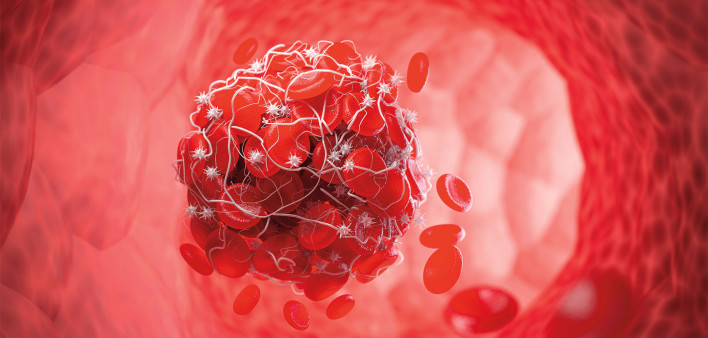
When beloved comedic actress Catherine O’Hara (Home Alone, Schitt’s Creek) died earlier this year of a pulmonary embolism, doctors cited her rectal cancer as an underlying cause of death. O’Hara’s cancer caused a blood clot that traveled to a pulmonary artery in one of her lungs, blocking blood flow and oxygen to the organ. The news focused attention on blood clots as a life-threatening risk associated with certain types of cancer, such as rectal, colon, lung, pancreatic, stomach, kidney and multiple myeloma, as well as some cancer treatments.

Catherine O’HaraCourtesy of Catherine O’Hara
Taking simple steps like the ones below can help lower your risk and keep blood flowing smoothly.
- Talk with your healthcare providers. Ask about your risk factors for blood clots based on your cancer type and treatment, the medicines you take—prescription and over-the-counter drugs and supplements—and other health conditions, such as being overweight, which can increase pressure on the veins. If you are at risk, ask about the common signs of a pulmonary embolism, such as chest pains and shortness of breath, as knowing this is key to getting diagnosed early and starting treatment.
- Stay physically active and sleep smart. Regular movement keeps blood flowing normally. If you’ll be sitting for long periods—for example, while traveling by car or plane—try to get up and walk or at least gently stretch and bend your legs, knees and ankles every one to two hours. This lowers your risk for deep vein thrombosis—the formation of clots in a deep vein, usually in the legs. Also, avoid crossing your legs while sitting or lying down, as blood clots can form during sleep. If possible, lie on your back and slightly elevate your legs—the best sleep position for preventing clots. Don’t curl up in a tight fetal position, as this can restrict blood flow. Hydrate and stretch a bit before hitting the sack to further reduce clot risks
- Say no to smoking or vaping. These addictive habits introduce nicotine into the body. A psychoactive chemical, nicotine constricts blood vessels and causes components in blood to become sticky, thickening it and slowing its flow, thus boosting its tendency to form clots. Similarly, frequently smoking cannabis, or weed, is linked with an increased risk for cardiovascular disease, including poor artery health, heart attack and stroke.
- Consider wearables. These range from simple compression stockings to intermittent pneumatic compression (IPC) devices. An IPC device is a cuff, or sleeve, that encloses just the calf or the entire leg. It’s connected to an electric pump that triggers a repeated cycle of inflation and deflation—much like a blood pressure cuff— that massages the lower limbs to increase blood flow through the leg veins, which helps prevent clots.




Comments
Comments