

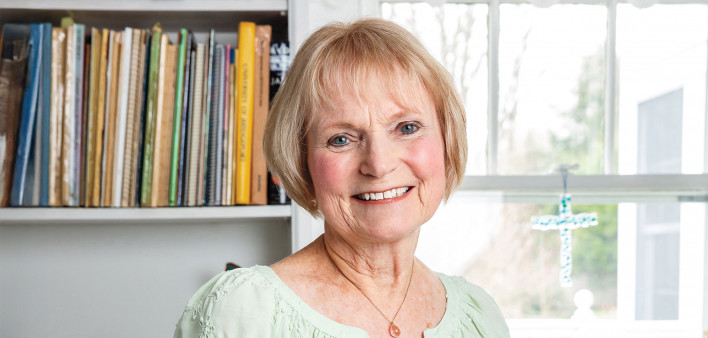
Last year, the other shoe dropped for Carolyn Shay, 74, and her family. In 2019, the retired licensed clinical social worker was diagnosed with monoclonal gammopathy of undetermined significance (MGUS), a condition characterized by altered plasma cells, a type of white blood cell arising in bone marrow. At the time, she had no symptoms, but having MGUS raises the risk of developing cancer. For the next four years, she was tested every six months to make sure the condition hadn’t progressed; because it remained stable and she felt fine, the testing frequency dropped to once a year for the next two years. But at her January 2025 checkup, “things had drastically changed,” Shay says. A key blood marker was elevated, and after multiple bone marrow biopsies, a 24-hour urine test and a PET scan, she learned she had multiple myeloma, a rare blood cancer.
Before she received this unwelcome news, Shay’s routine had revolved around her six grandchildren—“the delight of my life,” she says—who all live near her home in Woodbury, Connecticut. She retired in 2015 from a decades-long career counseling elementary school children and their families in the Naugatuck school system, a job she loved, to devote time to helping babysit her grandkids. They often slept over, and on weekends, she and her husband attended all their sporting events—soccer, lacrosse, basketball and swimming. Her days were also happily spent singing in her church choir, walking outdoors and being in nature, volunteering for hospice, reading, sewing and, during warm weather, gardening.
With her new diagnosis, Shay had to shift a lot of her energy to medical consultations, cancer treatments and learning to cope with her illness.
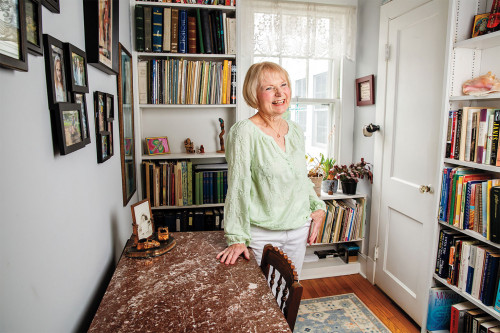
Carolyn Shay hopes her new drug regimen puts her cancer in remission.Jane Shauck
A Clinical Trial…and a Grant
When Shay was diagnosed with MGUS, her doctor referred her to an oncologist/hematologist at the Harold Leever Regional Cancer Center in Waterbury, which is affiliated with Yale New Haven Health’s Smilow Cancer Center. The multiple myeloma diagnosis required three bone marrow biopsies: two at Waterbury Hospital and a third at Yale. “They weren’t getting as definitive a diagnosis as they wanted, based on genetic markers,” Shay explains.
Her case was then presented before the multiple myeloma board at Yale, and she was offered the opportunity to participate in a 16-week clinical trial of targeted therapy approved by the Food and Drug Administration. She would also be on two other cancer-fighting drugs and a potent steroid.
Amid the flurry of tests and treatment decision-making, Shay didn’t recognize a looming problem: How would she pay for her medications? She participates in a Medicare Advantage plan, and as retirees, she and her husband, a former music teacher, live on a fixed income.
Fortunately, a nurse in charge of medications at the Leever Center anticipated Shay’s need for financial help. She connected Shay with the HealthWell Foundation, which provides grants for medications for underinsured people who have cancer and other chronic or life-altering illnesses. In 2025, HealthWell awarded close to 124,000 grants to oncology patients, according to its CEO and president, Michael Heimall. (See “How HealthWell Can Help,” page 17.)
A couple of weeks after applying, she learned that she had been approved for a drug co-pay grant of $8,000.
The Grant Kicks In
On August 8, 2025, Shay’s participation in the study ended. A PET scan and blood work showed she was in partial remission. “I still had some myeloma cells present in my bone marrow,” she says. To address this, she was to start a new treatment regimen, this time swapping in “a tried-and-true” immunomodulatory drug, Shay says, along with two of the same drugs she’d already been on, plus the powerful steroid. She would undergo three cycles between September and early November.
When she learned that the replacement drug can cost thousands of dollars per cycle, Shay again contacted HealthWell, which assured her that her 12-month grant was still current. While in the clinical trial, she had paid only a little over $2,000 for her drugs, so she hadn’t yet accessed any of the grant funds. “It has been such a godsend,” she says, “because my insurance only covers $200 a month of the cost.” Instead of stressing about money, she has been able to focus on her health and spending time with her family.
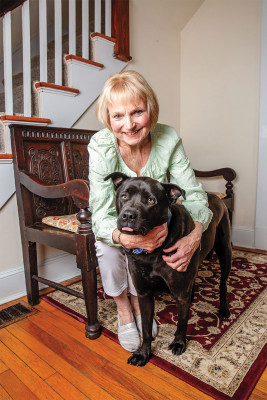
Carolyn Shay aims to balance joys and health.Jane Shauck
Harvesting Stem Cells
The next hurdle was undergoing apheresis to harvest Shay’s stem cells in case she needs a stem cell transplant in the future. Her son Wesley, a registered radiologist assistant at Memorial Sloan Kettering Cancer Center in New York City, has helped his mother navigate the complexities of her care. For example, he recommended that she request a Quinton catheter to facilitate the harvesting. It can take several days, but “I was so fortunate,” Shay says. “They were able to get—I believe it was 40 million stem cells in one day over five or six hours.” Afterward, the cells were frozen and stored for later use.
Shay went off her meds for a few weeks before and after the apheresis and then resumed the same drug cocktail. In February, the Yale multiple myeloma board considered her case again and recommended that a stem cell transplant be put off and another adjustment be made in her drug regimen, this time to replace one med with another one designed to treat refractory (treatment-resistant) multiple myeloma. In early spring, she started on two cycles of the new regimen, which she found debilitating. One of the drugs, which she took orally at night, caused terrible insomnia. She switched to taking the drug during the day, which solved the problem.
Shay’s grant expired in March, but she was able to apply to HealthWell for a new grant for $8,000, this time over the phone, and was approved during the call. It covers co-pays for the same drug. The grants are saving her up to $16,000 for two years of treatment. “We struggled as teachers,” she says. “We didn’t make huge salaries. And knowing that I don’t have that financial pressure—because I know what it’s done to people who haven’t had a financial backup—has been a great relief and lessened a tremendous stress. I’m just so grateful for that.”
Adjusting to a New Normal
If her current drug regimen puts her into remission, Shay says, she is likely to stay on it. “If it does not, a stem cell transplant certainly still looms in my future.”
Throughout this period, Shay has found it hard to find a balance in her life so that she has some normalcy and is still able to protect her health. So she incorporates the activities she loves—walking outdoors every day, exercising and eating organic food. Her garden and the promise of peonies, her favorite flower, bring her joy. She has returned to singing in the choir and wears a mask to church to reduce her risk of infection. “Prayer is very important to me. My prayers and those of many in my church and my circle of friends have really sustained me,” she says. She rises early, between 4 a.m. and 4:30 a.m., has breakfast and then reads scripture and prays for up to an hour every day.
Shay sees her grandkids every week, getting two of them off the school bus on Thursdays and staying with them until their mother, her daughter-in-law, arrives home from work. She still attends all her grandkids’ sports events.
Another challenge has been learning to receive. “I was a social worker for all those years, and I volunteered at my church—we’d take meals to people who are ill or had a death in the family,” Shay says. When she hasn’t felt like cooking, members of her church have brought over dinners. “Learning to be on the receiving end, graciously, has been a life lesson for me.” Friends from college and even one from high school have sent flowers, cards and gifts. “That just lifts your spirits, really, when you’re feeling like, Sigh, another day of this.”
When Shay was first diagnosed, her son Wesley said to her, “Mom, two of the things I see that make the biggest difference are a positive attitude and a support system.”
“I feel very blessed that, for the most part, I have had a positive attitude,” she says. “I have had my dark days. But I have a wonderful support system. That has helped to sustain me through this—that and knowing that I don’t have the financial stress.
“My hope is that in sharing my journey, that it will help someone else, take away some of their fear or maybe spark questions for them to ask,” she adds. “None of us want this, but if we can help each other through it, that would make me very happy.”
SIDEBAR:

Doriot Kim
How HealthWell Can Help
Since its founding in 2003, the HealthWell Foundation has provided more than $5.2 billion in financial support to more than 1.3 million people with life-threatening diseases. In fact, it has provided medication copayment and insurance premium assistance to over half a million people living with cancer. And in 2025 alone, the foundation awarded more than 440,000 grants. The grants primarily cover drug treatment costs for a wide range of cancers and other illnesses. There are also funds for a limited number of other needs. For example, anyone who already has a grant and needs money for rides to and from medical appointments can apply for help from the foundation’s general travel fund. In addition, “we have special initiative funds to assist oncology patients with behavioral health services that help cover prescriptions and counseling psychotherapy,” says Michael Heimall, HealthWell’s president and CEO. As a pharmaceutical co-pay program, “we don’t cover hospital bills, radiation therapy, those types of things.”
As of spring 2026, HealthWell has 19 open oncology funds with money available for grants. Maximum oncology grants range from $2,000 to $10,000 and are available for 12 months. To qualify for assistance, an applicant must have:
- Some form of health insurance;
- A disease that’s covered by the fund they are applying for (this requires a diagnosis verification signed by their healthcare provider);
- A household income that doesn’t exceed 500% of the federal poverty limit.
“If all the eligibility criteria are met at the time of enrollment, they can receive instant approval and begin using their grant,” Heimall says. The only other reason someone might not qualify for a grant is if a drug being prescribed isn’t approved by the Food and Drug Administration or listed in the United States Pharmacopeia (a drug compendium) or if their insurance company refuses to cover that particular treatment.
HealthWell receives hundreds of letters and emails from patients every month, “and what we hear all the time is that without our assistance, they would either not fill prescriptions or not take them as prescribed, or they might forgo treatment, or they would have to move out of the apartment they were living in and find a more affordable place,” Heimall says.
To apply, go to HealthWellFoundation.org or call 800-675-8416 between 9 a.m. and 5 p.m. ET Monday through Friday.




Comments
Comments