

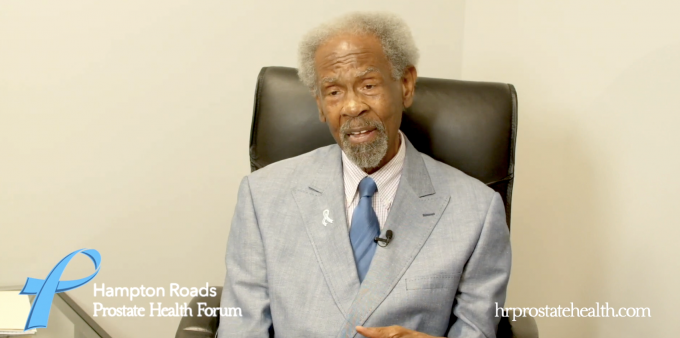
After more than two decades of sharing his experiences as a prostate cancer survivor, Charlie Hill, 81, has learned a thing or two about successful advocacy. He has also earned a nickname: “I talk so much about it, people started calling me the Prostate Man,” Hill says.
A retired human resources leader at Landmark Communications, Inc. and a board member on numerous civic, health and business groups, Hill cofounded the Hampton Roads Prostate Health Forum in 2007 and currently helps lead the nonprofit’s outreach in Norfolk, Virginia Beach, Hampton Roads and neighboring areas in Virginia. (Hill also met his second wife through the group.)
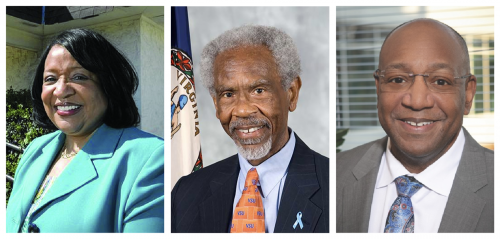
From left: Golden Bethune-Hill, Charlie Hill and Dr. Mark Fleming cofounded Hampton Roads Prostate Health Forum.Courtesy of Hampton Roads Prostate Health Forum
This summer, the nonprofit joined the First Baptist Church Denbigh in Newport News, Virginia, to hold a full-service Prostate Cancer Early Detection event. Hill also led an educational session at the Hampton University Ministers Conference.
Currently, he and his team are gearing up for the fourth annual Prostate Cancer and Men’s Health Fair held Saturday, September 27, at the Hampton University Proton Cancer Institute, where they aim to get 500 men tested on-site for prostate cancer. You can visit HRProstateHealth.com and scroll through their Facebook page to learn more about the group’s events—and to access educational materials and videos.
Cancer Health spoke with Hill for the latest installment of our Can Heal column—the empowering phrase “Can Heal” is right there in our title. He graciously shares his personal journey with numerous health challenges and offers inspiring insights along the way. Our interview has been edited for clarity and length.
Can you briefly recount your cancer story?
My first wife was diagnosed with lung cancer. We were in shock. She was a nonsmoker and young—in her early 50s—but that was a gift for me because it opened my eyes to what could happen. We shared some doctors, and one said to me, “You should get tested [for various other health issues].” One doctor flagged something she saw out of range regarding prostate cancer. That was a shocker to me. I had no symptoms, my PSA was 2.0-something and my dad never had it. So we did a biopsy, and, lo and behold, it came back with evidence of prostate cancer.
I ended up at Johns Hopkins, where they called me the “no-symptoms guy,” and I decided to do surgery in 2002. I asked if they could get rid of the cancer but still allow me to have sexual function. I was in my 50s and didn’t want to shut down totally. They said there was a fairly new nerve-sparing procedure—I don’t think it was computerized like today—but I was delighted.
They removed the entire prostate gland. Things went well, but then I had a recurrence a couple years afterward, in the area where the prostate was. I was treated with radiation, which was effective. I’ve had no more [recurrences] after all these years.
What motivated you to speak publicly about this?
Through dealing with this and with my first wife’s cancer, I realized how important it was to have someone to talk with who knows what they’re talking about. People hardly talked about cancer, but when you add “sex gland,” it’s really not an easy topic. I concluded that if I survive this, one thing I would do is help people understand what they need to know—both men and women. Women were easier to convince to talk about it, but they were pushed away by the men.
From your experience, what’s the best way to approach this topic?
I talk about intimacy. I used to use the word sex, but it made too many people uncomfortable. Women, for sure, want to talk about intimacy. I have actually experienced what a lot of people are reading about and don’t have anyone to talk with. They ask questions on topics like insurance and functionality, like, “Could you have an erection and control urination?” And I tell them my experiences.
I say, “Look, as we all get older, we’re going to have health issues, and we need to take care of them in time to make a difference. If you deal with [a health issue] before it’s a known problem, chances are greater that it will be treatable.” I’m public about my situation. When I was a caregiver for my first wife, I did crazy things, like work all day and stay up with her at night. And you know what happened to me? I had a heart attack in 2001. Since the heart attack, I learned to eat better and exercise. I also have lymphoma [a blood cancer], and I have to check that out on a regular basis. And I have Dupuytren’s contracture [a thickening of tissues in the palms that causes the hands to curl].
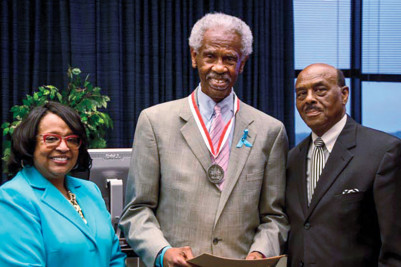
From left: prostate cancer advocates Golden Bethune-Hill and Charlie Hill with former Hampton Mayor George E. WallaceCourtesy of Hampton Roads Prostate Health Forum
I say, “Look at me, cancer and other health issues have not stopped me from living a high-quality life. You can have medical conditions, and it’s not the end of the world, but you have to do what’s appropriate for your health and wellness.” I talk about these things in the context of a person who is living it. And it becomes inspiring. People think, Maybe I’ll get better too. Maybe it will make a difference if I stop drinking or eating poorly. It becomes real. It’s important to capture these positive stories.
You hold a lot of educational sessions at churches. What’s the connection?
The church is so important, especially in the Black community, where prostate cancer numbers are the worst. I’ve been going to church all my life. Even though the churches have weakened in [attendance] numbers, the Black churches continue to be strong and effective in reaching Black men. When you connect those things—the church, and include both men and women, and then talk about health and wellness, doing better in your life—then it becomes an attractive opportunity. That formula is working. And the church makes people more comfortable. It’s the most efficient way to make a positive difference in the short term. It will become increasingly more helpful as we go forward.
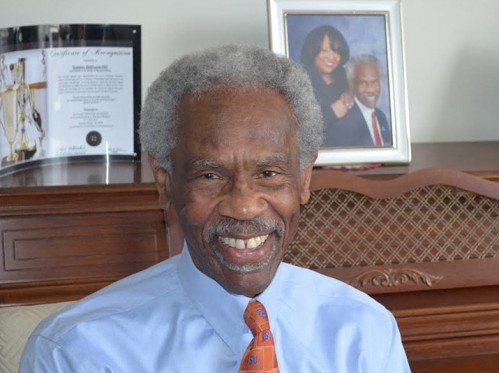
Charlie Hill is a prostate cancer survivor and advocate in the Hampton Roads region of Virginia.Courtesy of HRProstateHealth.com
Finally, aside from doctors and treatments, what has helped you heal and cultivate such a positive attitude?
The short answer is I have the satisfaction of knowing that what I do can help other people and other families. When we have open conversations about what can be done before a diagnosis, it makes a huge difference. I want to see more and more Charlie Hills.



Comments
Comments