

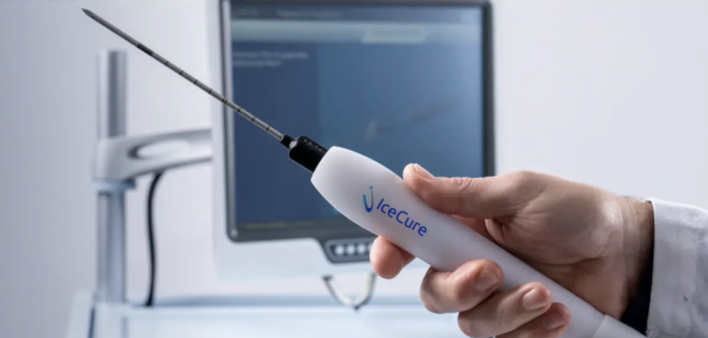
The Food and Drug Administration (FDA) has granted marketing authorization for the first cryotherapy treatment for older women with early-stage, low-risk breast cancer. Cryoablation, which destroys small tumors by freezing, is a less invasive method that causes minimal scarring and has a shorter recovery time compared with surgery.
The ProSense Cryoablation System, from IceCure Medical in Israel, uses a probe that administers liquid nitrogen. The ultra-cold temperature (-170C°) creates an “ice ball” around the tumor that freezes and destroys the abnormal tissue. The procedure can be done in a doctor’s office in less than an hour and requires only local anesthesia; patients can usually resume daily activities within a day.
The FDA approved the new method for women ages 70 and older with early-stage, biologically low-risk breast tumors no larger than 1.5 centimeters and no evidence of cancer in lymph nodes who also use adjuvant endocrine (hormone) therapy. Such patients are often considered unsuitable for surgery. IceCure estimates that around 46,000 women in the United States fall into this group each year.
“We are excited to add a minimally invasive choice around breast cancer treatments and to offer patients an effective, outpatient procedure,” IceCure CEO Eyal Shamir said in a news release. “With the ProSense Cryoablation System, we are giving women with low-risk, early-stage breast cancer the choice to freeze their cancer, not their lives, through an effective treatment that minimizes recovery time, and minimal cosmetic changes to the breast.”
Cryotherapy is increasingly used to treat small benign or malignant growths, including kidney, liver and lung cancer. There is some evidence that destroying tumors with ultra-cold temperatures may stimulate an immune response against residual cancer cells. While several cryoablation devices are on the market, this is the first approval for early breast cancer.
The FDA authorization is supported by results from the ICE3 study, a single-arm trial that included about 200 women ages 60 and older with early-stage hormone receptor-positive/HER2-negative noninvasive breast cancer who opted for cryoablation in lieu of lumpectomy. As reported in the Annals of Surgical Oncology, an interim analysis at three years showed that 2% of patients experienced disease recurrence in the same breast. The recurrence rate was 4% at five years, but fell to 3% among those who used adjuvant endocrine therapy, according to a presentation at last year’s American Society of Breast Surgeons annual meeting.
“The ICE3 study has proven that cryoablation with ProSense is a safe, minimally invasive ablative procedure with results similar to that of lumpectomy patients who took endocrine therapy and has the benefit of being an office-based, nonsurgical treatment,” said lead study investigator Richard Fine, MD, of the West Cancer Center and Research Institute in Tennessee.
Cryoablation was safe and generally well tolerated. Procedure-related adverse events included edema (swelling), bruising, skin burns and postoperative pain. In the ICE3 trial, adverse events were typically mild to moderate, and no severe device-related adverse events were reported.
“You don’t need any kind of cosmetic follow-up, you don’t have a scar, and you don’t have the feeling of having lost part of your breast, because it’s all still there,” study participant Pam Dixon said in the IceCure news release. “There was no pain. It was one of the easiest things I’ve ever done. I don’t remember any limitations on my activity.”
Some participants at an FDA advisory committee meeting last year expressed concerns, noting that the nonrandomized trial had no control group, and the study population was at low risk for recurrence even without treatment. Nonetheless, the panel voted 9-5 that the benefits likely outweigh the risks. IceCure requested authorization for women ages 60 and older, but the FDA went with a higher cutoff of 70 years.
To confirm the benefits of the procedure, the FDA has asked the company to conduct a postmarketing study that will include around 400 patients at multiple sites.
Click here for more news about breast cancer.



1 Comment
1 Comment