

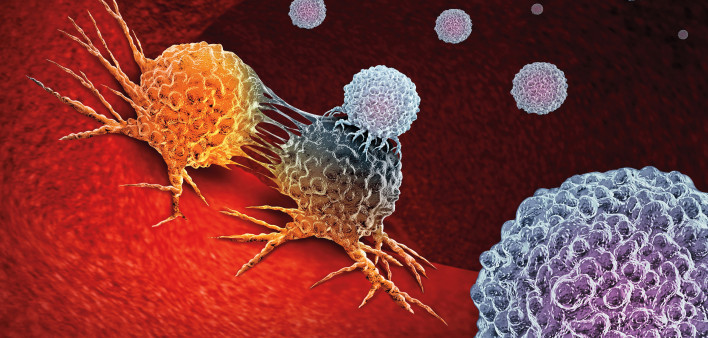
A combination therapy that stimulates immune memory and delivers a cancer vaccine can boost antitumor responses, according to new research involving human patient data and mice. These findings, published in Science Immunology, could inform new strategies for cancer vaccines, which have shown limited efficacy in early clinical trials.
Despite ongoing research, there is a lack of effective therapeutics that can induce long-term immune memory for potent antitumor immunity.
Here, Bin-Jin Hwang, of Duke University, and colleagues investigated the relationship between tumor antigen-specific vaccine efficacy and long-lasting T-cell responses.
The researchers analyzed samples from seven patients with advanced HER2+ breast cancer who received HER2-targeting, dendritic cell-based vaccines – all of whom survived more than 18 years after vaccination. The analysis revealed a population of HER2-specific T cells that express CD27, which plays an important role in long-term T cell memory.
In mice that express human CD27, simultaneous delivery of a HER2 vaccine and , with the largest effect on long-lived CD4 memory T cells.
Mice bearing HER2+ breast cancer tumors also showed much higher antitumor immunity in response to combined treatment with the vaccine and the CD27 agonist, when compared with the vaccine alone as a control. Tumor growth in mice was further inhibited when the two treatments were combined with anti-PD-1 checkpoint inhibition therapy.
Using RNA sequencing, Hwang et al. determined that the combination therapy changed the immune cell makeup in the tumor microenvironment and drove CD4 T cells towards a more activated, effector-like profile.
The authors speculate that activated CD4 T cells may stimulate CD8 T cells, suggesting that CD27 agonized vaccination might rely on both cell groups.
“Future studies will also be required to dissect how CD27 signaling drives vaccine-induced immunity [...], with the aim of extending this approach to other cancers and infectious diseases,” Hwang et al. write.
This news release was published by the American Association for the Advancement of Science on December 19, 2025.




Comments
Comments