


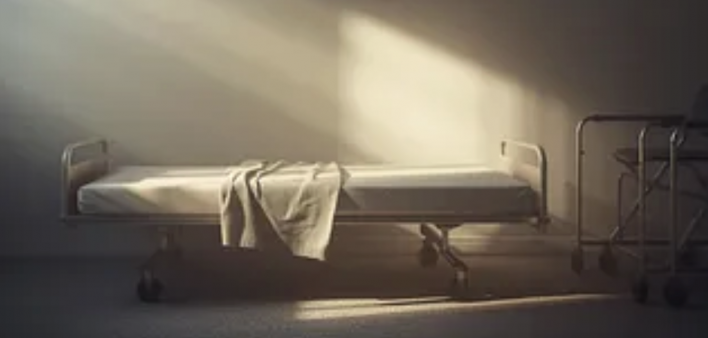
Mornings have their own choreography now, but it’s the off-Broadway, shoestring-budget version, performed with a sketchy wheelchair, an old walker that complains louder than I do, and a gait belt I wear like a pageant sash for the world’s least glamorous competition.
The real equipment — the hospital bed, the Hoyer lift, the sit-to-stand device — is coming with hospice in the next few days. For now, we’re improvising. And by “we,” I mostly mean Whitney’s shoulder, the one we are desperately trying not to destroy with every sideways lean, misjudged pivot, and gravity-assisted collapse. She absorbs more of me than any living person should ever have to, and she does it with a steadiness that turns care into instinct.
Even so, all is not lost.
Last night, I managed to adjust myself in bed without falling out, without panic, without the familiar scramble to rescue my 50-pound deadweight left leg from trapping itself under the blanket like it’s trying to burrow to safety. It was a ridiculous, tiny triumph — the kind that used to be automatic and now feels like crossing a finish line no one else can see.
Activities of Daily Living (ADLs) have quietly transformed into Accomplishments of Disabled Life—dying life? Every transfer, every pivot, every inch of unassisted movement is a victory worth naming precisely because they are getting rarer.
And all of this sets the stage for what is to come.
I’ve outrun the statistics so long that even the tumor seems annoyed.
People imagine decline arriving like a thunderclap: a sudden, cinematic moment when everything changes. In reality, decline is a comedy of small indignities. A foot that stops lifting like it used to. A fall in the kitchen that feels half-tragic, half-slapstick. A bladder that has apparently gone freelance without consulting me. And headaches that show up the second I lean wrong; positional booby traps that hit like a reprimand from inside the skull, as if my brain has started enforcing its own gravitational rules.
It’s the pattern, not the PET scan, that breaks the news. What we may say are both clinical and radiographic findings, not one without the other. Partners in crime.
Then comes the absurdity of care at this stage. Only in glioblastoma land is hospice presented like a spa brochure: Would you prefer comfort? Dignity? The luxury package?
“Your Medicare will cover a lot of this!”
Whitney exclaimed after a meeting with the social worker.
In fact, and I can’t believe this is a sentence I now get to write, I’m being offered (“offered”) the hospice version of modern convenience: the Foley catheter. For the blissfully unfamiliar, it’s essentially a silicone tube that steps in when your bladder has taken an extended leave of absence. A personal assistant for urine.
Thank you, hospice. Oy.
Before saying more, here’s the straightforward version we shared with a small circle.
A recent update we shared privately:
We learned this week that the tumors are progressing again. Chemotherapy is no longer effective, and radiation isn’t an option because the area has already been treated twice. We have a couple of appointments lined up next week to discuss symptom management, but at this point, there’s no intervention that can control tumor growth.
— A&W
We shared this with a few neighbors so they’d understand why we might seem a little thinner in our cheer than usual.
We continued:
We’re not discussing this publicly yet, and we’ll be talking with the kids after the upcoming appointments. No need to reply — we just wanted people to know what’s happening and to be thoughtful in conversation until we’ve shared it more broadly.
Here’s the truth underneath all of that:
The body reveals the truth long before scans do. Lived experience is its own diagnostic clarity. I’ve known something was shifting, not from one dramatic symptom, but from the accumulated pattern of them. Eight and a half years into this improbable run, the data, the scans, and my own body are finally all in agreement.
That agreement points toward hospice.
And hospice, despite the brochures, is not surrender. It’s orientation. It’s the moment you stop asking “What can we do to control this?” and start asking “What matters most with the time that remains?”
You don’t have to fight everything. Some things ask to be faced instead.
Hospice is support, not abandonment.
Presence, not panic.
It’s choosing clarity over frantic grasping. Choosing days shaped by attention, comfort, humor, and the people who have walked the long road with me.
If this is the next stage, I want to meet it with the same values that have carried us since the beginning: honesty, informed consent, irreverence when appropriate, and love where it matters.
I’m still here.
I’m still writing.
And I’ll keep telling the truth as long as I can, in whatever shape it now takes.
Thank you for walking with me.
Thank you for reading.
Thank you for bearing witness to this long, strange, astonishing story.
This blog post was published November 16, 2025, on Glioblastology. It is republished with permission.



Comments
Comments