

Merkel cell carcinoma, or MCC, is so rare that newly diagnosed patients are often the first case their oncologist has ever treated. For many patients, understanding this aggressive skin cancer’s prognosis and treatment begins online, quickly leading to merkelcell.org — and the visionary team behind it.
Over the past two decades, Paul Nghiem, MD, PhD, and the Nghiem Lab have championed innovations in MCC treatment, delivering new treatment options, setting ever-higher standards of care and improving outcomes for MCC patients worldwide. And behind each breakthrough? A dedicated — and growing — community of supporters whose generosity fuels this progress.
Moving MCC research forward
Launched on January 27, the Merkel Cell Carcinoma Collaborative (MC3) Institute represents the next chapter in MCC research and care at UW Medicine and Fred Hutch. By connecting the Nghiem Lab with over 100 collaborators worldwide, the MC3 Institute provides a framework for sharing vital resources, supporting junior scientists and clinicians and advocating for patients worldwide. This global network ensures that today’s innovations reach patients everywhere while paving the way for even more advancements tomorrow.
Supporters may have encountered Nghiem, director of the Skin Oncology Clinical Program at Fred Hutch Cancer Center and the George F. Odland Endowed Chair in Dermatology at UW Medicine, in action firsthand — as a patient, or the spouse, sibling or child of a patient. They may be giving in honor or in memory of a loved one. They may have found him through the internet and felt more hopeful because of his research. But what has united this community — beyond a rare cancer diagnosis and its personal impact — is the expertise and unique resources offered by a team that globally leads in MCC research and care.
MCC moves fast — research must move faster
Navigating this aggressive disease can be overwhelming, especially when most people will have never heard of Merkel cells, the skin cells involved in touch sensations, until they receive their diagnosis. And the disease progresses quickly. What starts as a painless red bump on the face, neck or other frequently sun-exposed area of the body can quickly become a life-threatening cancer that is three times more likely to spread, or metastasize, than melanoma.
Each year, about 3,000 cases of the aggressive skin cancer are diagnosed in the U.S., a number that has steadily risen as the population ages. The earlier stages of MCC are more treatable, but 40% of patients will experience a recurrence, most within just two years.
Rewriting the standard of care
Historically, treatment options for metastatic or recurring MCC have been limited and outcomes uncertain — but that is changing. Fueled by philanthropy, Nghiem and his team led clinical trials establishing existing immunotherapy drugs as effective treatments for MCC, securing FDA approval for their use in the disease. These advances have reshaped national standards of care and transformed the prospects of patients with metastatic MCC: where once only 5% of patients had a lasting response to standard chemotherapy — formerly the only available option — now 50% see sustained benefits from immunotherapy.
The Nghiem Lab’s next goal is even more ambitious: a 75% response rate. To get there, they’re testing combinations of existing therapies, developing new drugs and studying strategies to prevent recurrence after treatment. Some current clinical trials are exploring the role of immunotherapy before and after surgery, while another is focused on advancing options for patients whose cancer returns after treatment.
Private support also empowers researchers to pursue early-stage projects, exploring novel ideas and gathering proof-of-concept data that can unlock larger grants. For example, philanthropy helped kickstart the team’s validation of a circulating tumor DNA test, a non-invasive blood test that provides patients and clinicians with critical real-time insight into treatment progress. Donations also partially funded the creation of a risk calculator, a tool developed by the Nghiem Lab to help tailor care to each patient’s unique needs.
“Philanthropy allows us to tackle more things at once,” said Nghiem. “Frankly, we have more good ideas than financial capacity to carry them out. Philanthropy makes more projects possible.”
Beyond immediate scientific advances, private gifts also sustain progress by training and equipping the next generation of clinicians and researchers. Clinical research fellows assist MCC patients with specific concerns while gaining critical expertise in MCC care, and a cadre of undergraduate students supported by philanthropy maintain the largest and most comprehensive MCC database in the world, ensuring a foundation of knowledge to fuel future findings.
A community in action
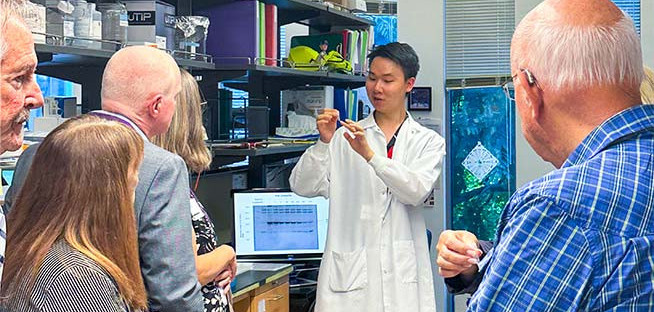
Hundreds of gifts come together to make a meaningful difference, and so do the individuals themselves. The annual Merkel CELLebration Dinner, hosted by the Nghiem Lab, is a time where patients, families and supporters join researchers to reflect on progress and envision what’s next for MCC research and care. Guests tour the lab space and hear updates from team members. Personal stories fill the room, weaving a tapestry of shared purpose.
And the spirit of this community extends well beyond the lab walls. In August 2024, members of the Nghiem Lab participated in their first Fred Hutch Obliteride as team Skin in the Game. With every pedal and step, the team channeled their shared determination to raise over $35,000 for MCC research.
From the heartfelt connections forged at the Merkel CELLebration Dinner to the high-energy camaraderie of Obliteride, these gatherings underscore a vital truth: progress in research is never achieved in isolation. Every person adds to this vibrant community. Patients and their families bring their stories of resilience and inspire urgency. Researchers contribute their expertise and innovation, pushing the boundaries of what’s possible. Supporters provide resources that help turn bold ideas into reality.
Just as community is built layer by layer, so too is discovery. The Nghiem Lab’s work exemplifies how science builds on science — each answer paving the way for new questions, every idea sparking the next and every breakthrough reflecting a collective commitment to a brighter future.
Your Reasons Power Progress
Everyone who supports Fred Hutch has a unique motivation. Together, those reasons power breakthroughs. Learn how others are turning their ’why’ into impact.
To learn more about how you can support the groundbreaking work of the Nghiem Lab and advance research and care for MCC patients, visit their Fundraise for Fred Hutch page.
This article was originally published February 6, 2025, by Fred Hutch News Service. It is republished with permission.



Comments
Comments