

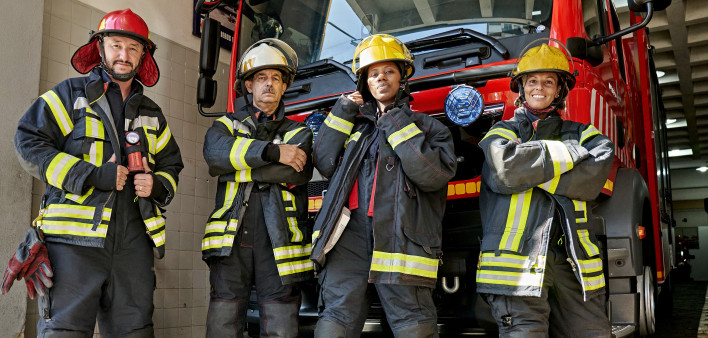
Firefighters wear special gear to keep them safe from harm, but cancer-causing chemicals and soot from blazes can cling to the surfaces of their standard-issue clothing and equipment. How can firefighters know whether they’ve been exposed to such a cancer risk? Turns out, there’s a simple solution.
A simple wipe test can detect these chemicals without damaging the jackets, pants and special masks firefighters need to safely and effectively perform their job, according to a news release from the University of Miami’s Miller School of Medicine about a recent study published in Journal of Hazardous Materials.
For the study, experts at the university’s Sylvester Comprehensive Cancer Center collaborated with investigators from Florida International University to swab designated areas of firefighter turnout gear with polypropylene wipes dampened with a specially mixed solution.
Next, scientists sliced the wipes into pieces and put them through an extraction process and then examined those samples using advanced mass spectrometry, an analytical tool.
“Think of it as turning on a blacklight in a dark room,” explained Alberto Caban-Martinez, PhD, DO, MPH, deputy director and investigator at Sylvester’s Firefighter Cancer Initiative, in the news release. “Suddenly, you see what’s been hiding all along.”
Results showed high concentrations of per- and polyfluoroalkyl substances (PFAS), also known as forever chemicals because they don’t burn or break down easily. These toxins are linked not only with cancer but also dementia, liver damage, reproductive health, and neurodevelopment in infants and children. Traces of PFAS also appeared inside firefighters’ breathing masks.
“It’s like smoke that never clears,” said Erin Kobetz, PhD, MPH, a study coauthor and the director and principal investigator at Sylvester’s Firefighter Cancer Initiative. “These chemicals ride home on gear, settle in firehouses and can end up in the bloodstream.”
According to findings from a study conducted by the American Cancer Society, firefighters face an increased risk for mortality from skin, kidney and other types of cancer. Hazardous exposures encountered by firefighters vary, but potential harms to health include known or suspected carcinogens found in gases, vapors and particulates, according to the Centers for Disease Control and Prevention’s National Institute for Occupational Safety and Health (NIOSH).
The agency had been working to recruit firefighters into its National Firefighter Registry to study cancer among firefighters, but massive layoffs and budget cuts at the Department of Health and Human Services last year resulted in the shuttering of entire laboratories and offices, including one that oversaw the firefighter registry.
But research into new ways to reduce firefighters’ high risk for death from cancer and other occupational hazards is ongoing.
“Future research should investigate how factors such as gear age, fire exposure frequency and laundering protocols influence PFAS retention in firefighter gear,” wrote the Miami study authors. “Ultimately, a multifaceted approach that combines exposure assessment, gear design innovation, policy development and ongoing health surveillance is needed to mitigate PFAS-related risks in firefighting occupations.”
To learn more about the high risk for cancer that firefighters face, read “Electric Vehicle Fires Raise Cancer Risk for Firefighters and Communities” and “Improving Care for Veterans and First Responders With Cancer From Line-of-Duty Exposure.”




Comments
Comments