

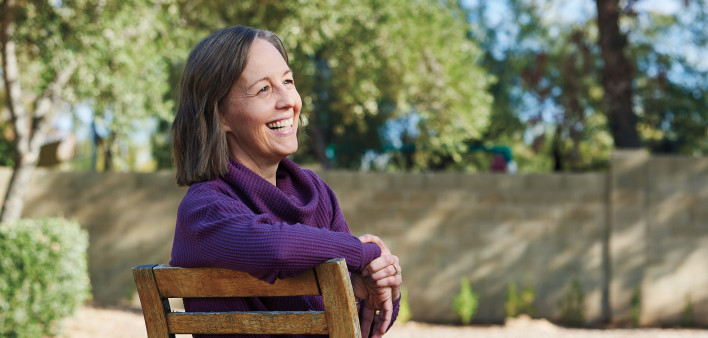
When Teri Wight, 51, of Scottsdale, Arizona, made an appointment to see her doctor in October 2014, she had no idea she was about to journey into uncharted medical territory. The middle school Spanish teacher and mom of two wanted to find out why her menstrual cycle was irregular—maybe perimenopause? The doctor recommended a follow-up ultrasound, which Wight had shortly before Thanksgiving. “I thought it was going to be something in my uterus,” she says. Instead, it was a 10-centimeter (3.9-inch) mass growing on one of her kidneys.
The doctor who broke the news to Wight was reassuring, telling her the growth appeared to be encapsulated within the kidney. “So he was very positive that, if it were to be cancerous, that it hadn’t spread,” she says. “And he said, ‘You know, I tell you it’s suspicious for cancer. Even if it is, on the ‘holy s--t’ factor, it’s probably about a six or a seven out of 10 just because of the procedure you’re going to have to go through.’”
Wight and her husband met with a urological surgeon in mid-December, and on Christmas Eve, she was wheeled into surgery to have her right kidney removed. Internal bleeding led to an emergency surgery almost immediately afterward followed by a two-day ICU stay, but she was able to make it home by December 31 to toast the new year with her family.
The pathology report pointed to chromophobe renal cell cancer (chRCC), an extremely rare malignancy. At the time, she was told, only 60 other people in the United States had the same type of cancer, which affects about 5% of people diagnosed with kidney cancer. Not much was known about it, except that “it doesn’t grow very quickly—most of the time. And it doesn’t metastasize—most of the time,” Wight says. Indeed, only 5% of cases become metastatic.
The post-surgery protocol called for having blood tests for kidney and liver function, an MRI of the abdomen with contrast and a chest X-ray every three months for two years, then every six months for another two years and then yearly. Wight was told there were no drugs to take because so little was known about the cancer. “I found that to be disappointing, but also, like, phew, thank goodness,” she says.
In seven short weeks, she had gone from being healthy to having a cancerous mass removed along with her kidney to being a cancer survivor. Now, she had to try to settle back into her regular routines of teaching and caring for her son and daughter, given that her doctors assured her that her cancer was unlikely to return.
Kidney Cancer on the Move
For nearly five years, Wight’s scans were clear and she remained cancer-free. But in December 2019, at the five-year mark, she had another MRI, and on her health portal she read the report that every cancer patient dreads. It noted suspicious lesions in her liver. “I was crushed,” she recalls. “The five-year mark in cancer is pretty huge. Well, every year is pretty huge, but five especially. You’re like, I’m probably going to be one of those where it’s not ever going to metastasize; I can put this away. But it showed up.”
A follow-up PET scan in January 2020 was negative. Wight went to see an oncologist who declined to put her on drugs, given their severe side effects, her age and that they likely wouldn’t be effective against chRCC. The tiny spot was still there, unchanged, on an MRI in March. But in June, another MRI revealed that the spot had grown, which required another surgery to remove it. This was at the height of the coronavirus pandemic, when the only people in the hospital were COVID-19, cancer and heart patients. “My husband literally dropped me off at the entrance and said, ‘I’ll see you in five days,’” she says. A biopsy confirmed that Wight had metastatic chRCC.
Accepting help from others is not a sign of weakness.
In September 2023, a second recurrence, next to the first spot, was cryoablated, or frozen away, in a procedure done by an interventional radiologist. Two months later, a third lesion was discovered and was removed laparoscopically in March 2024. In between the second and third recurrences, Wight started systemic therapy, with infusions of immunotherapy combined with an oral medication. She consulted a second oncologist who has treated chromophobe patients at MD Anderson Cancer Center in Houston. This one recommended a different drug combination—one he thought would be more effective—and Wight subsequently switched to two different oral medications. Her scans have been clear while she’s been on these new drugs.
Hard-Won Lessons
Having cancer is always challenging; having a rare cancer can be next-level challenging because so much about the disease is mysterious and unknown. For Wight, that meant living on a roller coaster while being told repeatedly, at different stages of her illness, to enjoy her survivorship because her cancer was unlikely to return. And yet it did.
One of the hardest truths she has had to accept is that there’s no guarantee that chRCC will be slow-growing or that it won’t metastasize. A second is that “there’s no treatment protocol, really, for what I have,” Wight says. “It’s just, throw stuff at it and guess.” Because of its rarity, there’s a lack of tumor tissue for research. And drug trials for clear-cell renal cell cancer, the most common type of kidney cancer, tend to exclude those with rarer cancers because their genetic profiles are different. “We know that a lot of the clear-cell drugs aren’t as effective for chromophobe,” she says.
Despite the many frustrations and disappointments, Wight has learned lessons that have helped her cope successfully with her illness and that she hopes might help others deal with their cancer.
You must advocate for yourself. “Early on, what really helped me was facing [my disease],” Wight says. “I’m a question-and-answer person. I like to know the facts.” It’s important “to research on your own and also just talk openly and honestly with your medical team.” If they don’t have the answers to your questions, ask them to look into it. “Or maybe you need to ask a different person until you find the right team that works well with you, your personality and also your disease,” she says.
Connect with the cancer community. Privacy is important—you may not want to talk about your cancer with other people if you have finished treatment and you’re returning to your life’s usual rhythms. But Wight is thankful that she is now connected with others who have kidney cancer and wishes she had reached out earlier, when she was first having recurrences and going through metastatic disease—or even further back, when she was diagnosed. “Within the last 18 months, I’ve found these organizations, like the Kidney Cancer Association (KCA). It is doing great work to connect, provide information, lobby and get funds for kidney cancer research,” she says. Something she appreciates now is learning how other people who have Stage IV kidney cancer manage their symptoms.
Address your stress. “I’m a type A, 100% perfectionist type of person,” Wight says. “But is that really what we need to be doing in life? Maybe I don’t need that stress.” Try looking at the areas in your life that you can control to see what you might change. What can you cut out? What do you not have to do? In your circle of friends, are there people who aren’t working as hard as you to maintain those friendships? If so, consider letting them go so you can keep close the people you know you can depend on. “When you go through this disease, you really get to see what’s important in life and what you should focus on.”
Let your family and friends support you. Having cancer is more than a physical burden; it’s an emotional one too. The people who love you can help carry that burden with you. As Wight wrote in a blog post on the KCA website, “I am a fiercely independent woman. Having cancer, however, has taught me that accepting help from others is not a sign of weakness or dependence; it’s necessary to my survival.”
Negative results on health portals can have a silver lining. While Wight acknowledges that it can feel awful to read your scary test results before getting a doctor’s interpretation of them, she also thinks it can be helpful motivation to prepare for a follow-up appointment. “When I see that kind of stuff, I’ll research and write down all the things that I want to ask my doctor,” she says. Just be sure to stick to the “dot-orgs” when searching online in order to access the most trusted, research-based medical information.
Cancer is hard, even when you have a “good” cancer. Some cancers have been labeled “good” because they’re supposed to be more treatable and have better survival rates, especially when found early. “I don’t like to hear that I have the ‘good’ kind of cancer,” Wight says. “Because no cancer is good.” No one who hasn’t had cancer or walked through it with someone close to them can really understand what it’s like, she says, “because even on the days when I feel better and good, I still think of it all day long.” Nonetheless, she is very grateful for the eight years that she didn’t have to take a single drug.
There are always reasons to be hopeful. When Wight was first diagnosed, she feared that she might never get to see her kids, ages 8 and 10 at the time, graduate from high school. Now, her daughter is in college, studying Spanish like her mom did, and her son will graduate from high school in the spring. As for the outlook regarding chRCC, things change every day in the medical field. More research is underway, and there’s hope that clinical trials for chRCC drugs may be in the works in the next few years. “I feel really positive, even now. I’ve gotten 10 more years out of all of this, so that’s good,” Wight says. “I don’t really think that if I get a recurrence again, I’m going to die tomorrow. I know there’ll be something to do about it.”
SIDEBAR
Talking to Your Kids About Cancer
When parents with cancer have to tell their kids about the situation, “I think you have to be honest and as positive as you can be,” Wight says. Her kids were young when she was diagnosed, and therefore they didn’t understand that much about serious illness. So she simply told them, “Yep, I have cancer. A lot of people do. They took it all out of me. So I am recovering now, cancer-free, and it’s going to be hard for a while as I recover. But I’ll keep following up. And if something comes up, we’ll just take care of it.” With older kids (including her own as they’ve grown up), though “you can’t hide what you’re going through from them. They have to know—and why you’re doing all these [treatments].” The best way to frame it, she believes, is: “I’m doing all these things, and I’m going through all this so that I can be with you.”



Comments
Comments