

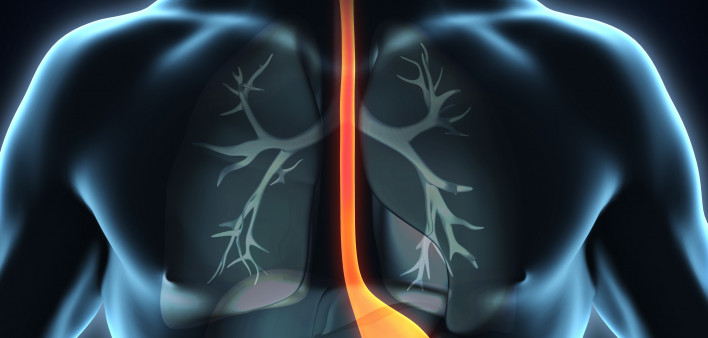
The esophagus is the organ in the throat that moves food from the mouth to the stomach.
Esophageal cancers make up approximately 1% of cancer diagnoses in the U.S., making them rare. Because many people who have esophageal cancer do not have any symptoms from the start, this cancer is often not diagnosed until at least stage 3, at which point the tumor is larger and may have begun to spread to lymph nodes.
“Esophageal cancers are hard to catch early,” said Jing Zeng, MD, who treats many patients with esophageal cancer at Fred Hutch Cancer Center – Proton Therapy. “Often the first noticeable symptom is that the tumor is causing a blockage, making it hard to swallow. Once it’s that large, it most likely has also spread to local lymph nodes, and if stage 4, to distant organs such as the liver.”
Some of the risk factors for esophageal cancer are smoking, heavy drinking, chemical exposure and uncontrolled gastroesophageal reflux disease (GERD). Patients who are being actively treated for acid reflux may find esophageal cancer early, because they may receive routine endoscopies. If caught early — when the tumor is tiny and superficial — treatment is easy and non-invasive through a method called endoscopic mucosal resection.
However, once the tumor is large enough to cause symptoms, treatment is extremely aggressive: chemotherapy with major surgery, or chemotherapy and radiation (chemoradiation) with or without the surgery.
“Usually, surgeons must remove the entire esophagus, which is a very delicate and thin organ that is challenging to operate on, and the stomach is moved up to the chest to connect to the throat,” said Zeng. “Having the surgery comes with the risks of any major surgery but can help with tumor control.”
Chemoradiation for esophageal cancer treatment is challenging.
A patient’s appetite is already reduced from the cancer, and they usually have trouble swallowing because of the tumor. Chemotherapy can cause nausea and taste changes. Radiation can burn the esophagus, making it painful to swallow. Eating can become a full-time job, just to get the nutrition needed.
In terms of radiation, Zeng often recommends proton therapy for treating esophageal cancer. The esophagus is in a challenging location to treat — in front of the spine, behind the heart and between the left and right lungs. When using radiation to treat esophageal cancer, it is important to deliver enough radiation to the cancer without damaging the healthy organs around the esophagus.
“Where protons are beneficial is in reducing the short- and long-term side effects to the other organs nearby,” said Zeng. “Surgery and conventional radiation can cause lung problems such as pneumonia and heart problems such as arrythmia. Protons reduce the radiation dose to those organs, and studies suggest that proton therapy may lead to decreased side effects from radiation treatment. That is why we often recommend protons as the preferred radiation treatment for esophageal cancer.”
If protons are not an option, it’s often because of other circumstances, such as logistics, insurance denials or other medical conditions, said Zeng. In these circumstances, Fred Hutch has other ways to treat esophageal cancer.
“Esophageal cancer is an aggressive cancer, but treatments are always improving,” said Zeng. “For example, immunotherapy after chemoradiation has shown promise, and new treatments are being developed.”
This article was originally published March 27, 2025, by Fred Hutch News Service. It is republished with permission.




Comments
Comments