

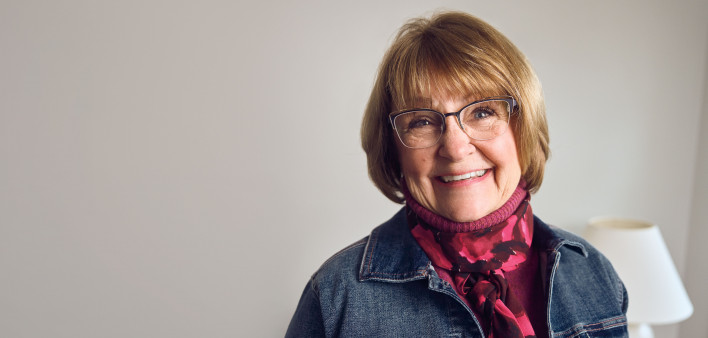
2008 is a year Albie Suozzi, 66, will never forget. It was the year her only son died in a motorcycle accident. Two weeks after that tragedy, she was diagnosed with chronic lymphocytic leukemia (CLL), the most common type of adult leukemia—accounting for 22% to 30% of cases—though it’s still considered a rare disease.
The diagnosis seemed almost incidental, Suozzi says. “I had no symptoms, nothing. It was just out of the blue.” Her job required employees to get a physical exam along with blood tests every year. In 2006, the testing revealed a too-high white blood cell count. When that test was repeated in 2007, with the same results, Suozzi was advised to see a hematologist, but she put it off until 2008.
Once diagnosed, she knew she had leukemia, but she had never heard of the specific type. She made it her mission to find out what she had and how to deal with it. As an educator—at one point, she was superintendent of a school district—she felt the more she could learn, the more she could be in control and better understand her disease. For her, that meant having a partnership with a doctor and conversations that made sense to both of them. But at the time, nearly 20 years ago, “there was nothing, I mean nothing, for support,” Suozzi says. “There were no support groups and very few reliable resources. So I did as much research as I possibly could with what good resources were out there to teach myself about the disease.”
Watch and Wait
Suozzi was placed on an active surveillance—also referred to as “watch and wait”—protocol involving blood tests every three or four months to monitor factors like her white blood cells and her absolute lymphocyte count, which gives a more precise picture of immune system status. The intervals between tests were increased when her lymphocyte count didn’t double.
It was a very stressful period, “because you always feel like you’re waiting for that shoe to drop—you know, as to what’s going to happen,” Suozzi says. The lack of treatments was also scary. BTK inhibitors, which have since transformed treatment, didn’t yet exist. “There was only chemoimmunotherapy, and not everybody responded to that,” she says. And there were gaps in the information she could piece together because her community-based hematologist couldn’t do certain critical tests that would reveal Suozzi’s degree of risk—low, medium or high—for aggressive disease.
Things changed in 2016 when her hematologist left to take another job. Suozzi had learned about FISH (fluorescence in situ hybridization) testing, a form of genetic testing to diagnose diseases caused by chromosomal differences. It was key to the information that was missing in her understanding of CLL. But the new hematologist she met with told Suozzi that they didn’t do FISH testing. So she investigated specialists in the Buffalo-Rochester, New York, area, where she lives, and subsequently switched to one at the Wilmot Cancer Institute at the University of Rochester. “I had all the tests done, and when they came back, he spent over an hour and a half with me explaining them,” she says. It turns out she has only one genomic marker and no aggressive ones, which means she has a low-risk, slow-growing form of the disease. “I felt so much better,” she says, both because of her low-risk status and also for finally having the information she’d been seeking.
Diet and Exercise Makeovers
Even before she knew her degree of risk, Suozzi decided she needed to alter her diet. “What made me look at it and decide to make some changes was the fact that all of a sudden, I was a cancer patient, I had CLL and I had no idea how I got it,” she says. “My diet was never horrible, but did I like fried Buffalo chicken salads and fried this or that? Sure, I did!”
Suozzi cut out fast food, added a greater variety of vegetables and more fruits, opted for olive oil and vinegar salad dressings instead of creamy ones and started to be more careful about the amount of red meat she consumes. Instead of snacking on a candy bar, she enjoys an apple or other piece of fruit. As an educational administrator, she found she was sitting more than she had when teaching. So she upped her exercise too, walking three or four miles a day. “It gave me more energy, and it still does,” she says. She found it helped with her fatigue, steadied her heartbeat, made her stronger and increased her ability to move faster and farther. Her husband or sometimes their dog accompanies her on these walks.
“They were simple changes,” she says of her efforts. “They weren’t anything drastic. But it made a difference in how I felt about myself and raised my self-esteem.”
Suozzi’s diet tweaks are also fueled by her home’s location in Medina, New York, near Lake Ontario, in what’s known as the Fruit Belt. “You name a fruit, we’ve got it,” she says. “Peaches, pears, cherries, berries. And it all grows beautifully.” In their 22 raised beds, she and her husband can grow a lot of produce, including tomatoes, peppers, sweet corn and squash. When they harvest everything, she freezes, dehydrates or cans it all, and they use it up over the following winter and spring each year. Now retired, she also volunteers to teach canning and preserving at the local cooperative extension, having earned her master food preserver certificate.
Starting on Meds
In 2023, after 15 years of active surveillance, Suozzi’s CLL started causing symptoms. Her spleen, usually the size of a fist, had extended all the way down her side to her navel, and she could feel it extending when she stretched in the morning. There were other signs too, including declining red blood cell, hemoglobin and platelet counts.
“Usually, there’s no discussion of options, but there should be some kind of shared decision-making between a doctor and a patient,” she says. She was pleased that her hematologist said, “Well, what do you want to do?” She had researched available medicines and decided that she wanted to try a specific second-generation BTK inhibitor. She chose not to participate in a trial, saying, “I want to do [the targeted BTK inhibitor] because I want to be able to go home and pop a pill twice a day until it stops working.”
Not unexpectedly, Suozzi experienced side effects within two to three days of starting the drug. She had migraine-like headaches, which she countered with caffeinated coffee. Her platelets kept dropping, and she became more anemic, which made her blood pressure drop. Her liver enzymes spiked, and her neutrophils plummeted to near zero. But there were positive signs too: Her spleen and lymph nodes were shrinking. Her doctor took her off the drug for a week and then put her back on a once-a-day dose, which reversed some of the side effects. After two weeks, he put her back on the two-dose regimen, and she’s been fine ever since.
“Everything I experienced is pretty much a normal reaction to the drug,” Suozzi says. “Some people don’t get side effects at all. Others get the side effects I had. So it’s just a matter of managing the medication so your body will get used to it.”
Working for the CLL Society
In 2018, Suozzi started a support group in Rochester for the CLL Society. She and a co-facilitator trained for a couple of days, located a building where they could gather and signed up a group of about 50 people for monthly meetings. COVID-19 forced the meetings to become virtual, which has allowed people from farther afield to attend; in-person meetings have yet to resume. Suozzi also created a one-to-one peer support program for the CLL Society, which she found especially rewarding. “Every time I got off the phone, I would feel good about being able to give back to somebody else,” she says. “I could give back that confidence that you can live with CLL a long time, you can see your grandkids grow up or whatever the case may be…. It was those one-on-one exchanges that I had with people that made a huge difference in my life. They’d always thank me, ‘Oh, it’s so great to have this conversation.’ But they didn’t realize what they did for me.”
Suozzi has also been a patient advocate for pharmaceutical companies and educational organizations, helping address how they might make a drug trial better for patients, improve drugs and discuss that with patients, find out what patients think about CAR-T therapy or help doctors understand the patient’s real-life experience when they’re on a medication.
The Role of Hope
“Science and research have come a long way,” Suozzi says. “There’s a lot going on now even with different cancers, things like cancer vaccines, things that are starting to go to trial.” She encourages people to sign up for a trial that’s available and looks good. “You’re not a guinea pig by any means. A lot of times these trials are to your benefit.
“You gotta have hope; you gotta have faith. As I said, science has come so far since 2008, when I was diagnosed—it’s amazing. There is hope out there.”
SIDEBAR
The Importance of a Specialist

Doriot Kim
Depending on where you live, you may only have access to a community-based hematologist who deals with many different types of cancer. But a specialist may be able to offer you better care. Here’s what to know when making a decision about your medical team.
- You may live longer. A 2025 study published in the journal Hematology found that among 6,372 CLL patients, those who saw a specialist in an academic setting tended to live longer than those who saw community-based hematologists, even though those patients had factors that could have led to a less favorable prognosis.
- You’ll have greater access to clinical trials. The same study also found that CLL patients who saw specialists in academic settings had higher participation in clinical trials. Trials can provide access to cutting-edge treatments.
- You may need to travel to see a specialist. If there is no academic medical center near your home, you may be able to travel to one, see a specialist and have your community-based hematologist coordinate with that specialist on your care.
- CLLSociety.org features a list of specialists. Under the “Info & Mgmt” drop-down menu, select “Newly Diagnosed” and then “CLL Doctor List.” There, you’ll find the CLL Healthcare Providers Directory organized by state, with links to each doctor’s institutional profile.



Comments
Comments