

I’m a registered nurse. I worked for many years in labor and delivery, then in IVF clinics and later for insurance companies. I obtained training as an end-of-life doula, which came in handy when we cared for my dad, a Holocaust survivor who lived to 99. I retired in 2021. I volunteer in hospitals with my therapy dog and co-facilitate groups for children who’ve lost loved ones.
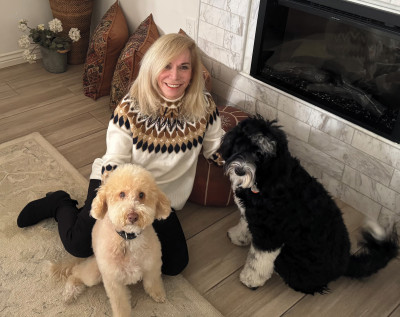
Susan Pack with Coby and LexiCourtesy of Susan Pack
My husband and I have been married for 48 years. We have three sons and three grandchildren.
April 2020
I noticed a reddened area on my left cheek. It was increasing in size. I saw a plastic surgeon, who advised me to see my dermatologist.
May 2020
The physician’s assistant at my dermatologist didn’t think it was anything but did a biopsy to reassure me. Six days later, she called to tell me I had tested positive for melanoma. It’s a rare type that’s pale or pink, rather than the typical brownish spot with darker speckles, which made it harder to detect.
I was blown away. I knew of people with melanoma who had died. I was fearful. But genetic testing came back with a metastasis-free rate of 97% over five years. I found that extremely reassuring.
June–August 2020
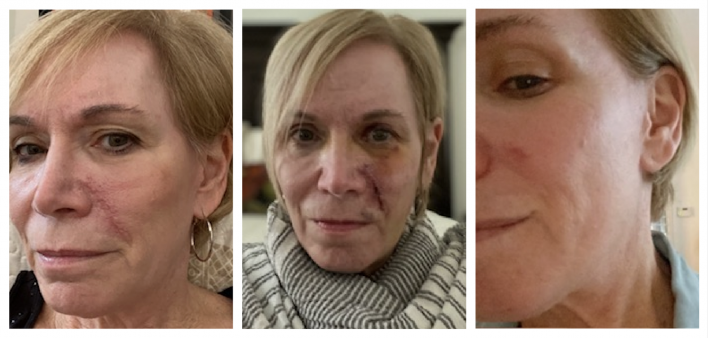
I was referred to a second dermatologist. She felt the lesion was too large for a slow Mohs surgery [in which minuscule layers of skin are meticulously removed and examined over a period of days until all the cancer is excised], so she referred me to an ENT [ear, nose and throat specialist] who had experience doing a wide local excision. He removed 9 square centimeters, about 11/2 square inches. The pathology report revealed potential residual melanoma, so additional treatment was advised. [Several weeks later] my dermatologist completed a slow Mohs procedure. I had a really huge scar on my face. Both providers monitored my healing and made recommendations for scar revision.
October–December 2020
A laser resurfacing treatment in October and a second one in December. They were very helpful in reducing the appearance of the scar. I saw my dermatologist for skin checks every three months. I was diligent about those.
June 2021
I had squamous cell carcinoma on my right lower leg. It was removed via Mohs.
February 2023
I had basal cell carcinoma in the same area, also removed via Mohs. I didn’t think too much about it. I’m fair-skinned. When I was a child, my father would say, “Go get a good sunburn.”
September 2024
I was seeing my dermatologist twice a year and doing well. But I was plagued by digestive symptoms that summer, so in September, I had a CT scan, which confirmed diverticulitis [the painful inflamation of tiny pockets inside the large intestine wall], which was treated with antibiotics. But a very diligent radiologist noticed an “incidental finding”—a nodule on the lower lobe of my lung—which hadn’t been there a year earlier. I made an appointment with a pulmonologist at the Mayo Clinic in Phoenix.
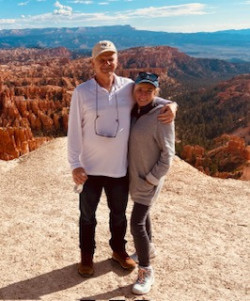
Susan Pack received support from her husband as well as melanoma support groups.Courtesy of Susan Pack
October 2024
At Mayo, they seemed fairly convinced that I’d been exposed to Valley fever [also known as coccidioidomycosis]—a lung infection caused by spores in the soil. Some people don’t have any symptoms. But I had a suspicion it was something more. I told them I had been treated for melanoma. They did a biopsy. Two days later, I was out walking my dog, and my phone went off with test results: metastatic melanoma. It felt like a death sentence. I just turned to my husband, thinking we were going to have our 50th anniversary in two years, and all I could say was, “I’m sorry. I’m so sorry.”
Somehow, I got grounded, with a lot of support from my husband. I got familiar with good resources. The Google maze was frightening and outdated, but the Melanoma Resource Alliance and the Mayo Clinic were invaluable. Over the next few weeks, I underwent MRI and PET scans, which, fortunately, confirmed that the metastasis was only in the lungs, not the brain.
November 2024
I saw an oncologist at the Mayo Clinic who specializes in melanoma. Dr. Mahesh Seetharam was so kindhearted and knowledgeable. I started on a checkpoint inhibitor immunotherapy drug. I started with a low dose every three weeks before going to a higher dose every six weeks, which is more convenient and just as effective. The protocol is for two years. I tolerated it fairly well, with one small very itchy rash. I would also get low-grade fevers and was fatigued.
The good news was, after three infusions, there was complete resolution of the nodule. It was too early to be considered remission, but the immunotherapy was clearly working well.
January 2025
I joined a melanoma support group through Mayo. It’s led by a licensed social worker. We meet once a month in person or on Zoom. I felt supported and comforted. Reddit has a good group too. It’s called Melahomies.
March 2025
As I started on the higher dose, I started to experience symptoms consistent with thyroiditis, inflammation of the thyroid gland. It’s a known possible side effect. I went into the clinic the next day for CT testing. But I had an adverse reaction to the dye: anaphylactic shock. I had trouble swallowing, my tongue itched, my heart beat fast. They called the ER nurse. I passed out. They gave me epinephrine and steroids and fluids. Now I know I’m allergic to iodine.
My takeaway from initial diagnosis to the current day: Be your own advocate. If you feel something, say something. Report all your symptoms.
April 2025
We’re planning a trip to see our son’s family in Crete, so I went to an allergist, who gave me epinephrine in case of an allergic reaction; I ordered an allergy bracelet that lists iodine. I had more symptoms, including neck pain, that sent me to the ER, where I was diagnosed with De Quervain thyroiditis, which can be managed with medications.
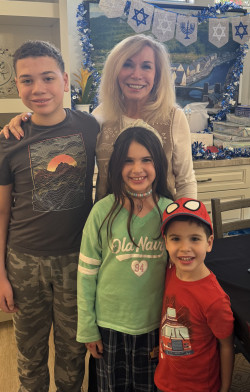
Susan Pack enjoys time with her grandkids.Courtesy of Susan Pack
I’m active. I like to volunteer, travel, take care of my grandchildren. But I am more tired now. I nap. I don’t like that. You know, this is my retirement.
People tell me to think positive. But I have to be prepared that my melanoma can reemerge. I follow the middle path—a phrase borrowed from Buddhism—avoiding extremes and finding balance, being neither overly optimistic nor catastrophizing. I worked with a rabbi, who came to our house and offered a really beautiful, centering song. And there’s the Hawaiian ho’oponopono prayer: “I’m sorry. Please forgive me. Thank you. I love you.” It’s just a few words, but it’s beautiful. And I walk the labyrinth, a meditation maze, at the Franciscan center: You go in circles, and at the end, you come to the center. It’s a very peaceful grounding.
I’m learning grace, as opposed to resentment. That’s a big step in my healing process. You know, when I was first diagnosed, I had a loop going around in my head, waking me up at night: I have metastatic melanoma. It didn’t serve me well. But after I attended a Zoom conference hosted by the Melanoma Research Alliance, I changed my outlook. Now, I think, I’m living with metastatic melanoma.
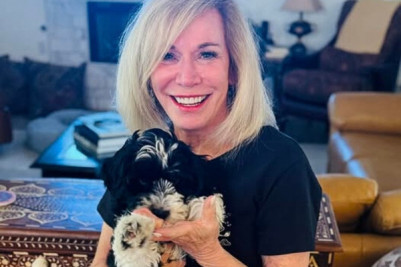
“Be your own advocate,” advises Susan Pack.Courtesy of curemelanoma.org



Comments
Comments