

What makes a rare cancer rare?
Sometimes, it’s the person’s age. All pediatric cancers, for instance, are rare cancers because cancer in the very young is highly unusual.
Other times, it’s the location of the tumor. Brain cancers are rarer than cancers in other organs because brain cells are protected against environmental exposures, unlike lung cells or skin cells, which are regularly bombarded with everything from respiratory viruses to UV radiation.
Usually, though, rare cancers are defined by the number of people diagnosed with them. In the United States, any cancer that has fewer than 40,000 new cases a year is defined as rare.
“A single rare cancer accounts for less than 2% of annual cancer diagnoses,” said Cassidy Hagan, PhD, a graduate from the University of Washington’s Immunology PhD program, during Fred Hutch Cancer Center’s Rare Cancer Patient and Caregivers’ Symposium held Saturday, March 14. “But collectively, rare cancers account for 27% of all cancers, which is a significant burden.”
In other words, individually, rare cancers are rare. Counted together, however, rare cancers represent almost a third of all cancers diagnosed.
That’s a large community, one that Taran Gujral, PhD, lead researcher for TRACER, Fred Hutch’s Transformative Rare Cancer Initiative, wants to help connect, inspire and empower.
“All of us ― patients, advocates, caregivers, researchers and clinicians ― are driven by a common goal: to improve the lives of patients with rare cancers,” Gujral said in his opening remarks. “If we work in silos, the progress will be too slow. Collaboration has to be the foundation of our effort.”
Meeting a ‘major unmet need’
A systems biologist in Fred Hutch’s Human Biology Division, Gujral created TRACER to focus specifically on rare cancer research, which he believes is a major unmet medical need that requires new, transformative approaches.
His lab researches rare cancers ― ependymomas, fibrolamellar carcinomas, rhabdomyosarcomas and many others ― in hopes of repurposing FDA-approved drugs as new potential treatments, a practice known as polypharmacology, which uses a “one drug-multiple targets” approach as opposed to the traditional “one drug-one target” model.
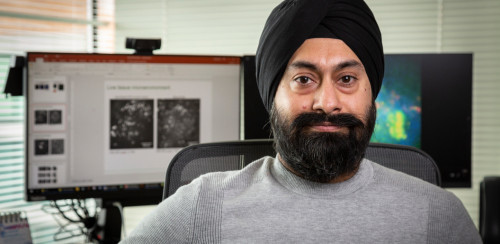
Fred Hutch’s Taran Gujral, PhD, launched TRACER, the Transformative Rare Cancer Initiative, with a $2.5 million grant from the U.S. Food & Drug Administration.Courtesy of Fred Hutch News Service/Robert Hood
Gujral and his TRACER team are also actively bringing together key stakeholders in the rare cancer community to encourage collaboration, build patient tissue biobanks and create tools ― rare cancer cells lines and mouse models ― that will lead to the discovery of additional therapies.
“Each sample is precious in rare cancer research,” said Deanna Mische, BSc, explaining the work she does as a research technician in the Gujral Lab. “Without our donors ― patients donating their tumor tissue ― none of these efforts would be possible. They are the cornerstone of our work.”
Gujral and team work with local oncologists and surgeons to identify rare cancer patients who might be interested in participating in their research. Those who agree donate their tumor tissue, which is usually collected during a surgical resection or needle biopsy.
“We use fresh tissue and need to receive it in a timely manner to maintain the living cells,” Mische said, explaining how the Gujral Lab “stretches” each tiny tissue sample to get the most out of it.
Patient tumor tissue is first de-identified, then transferred to tissue slides so the tumor’s genetic information can be extracted and profiled.
“From there, we can create microtumors to extend the testing capabilities,” she said. “We can do functional drug screening and identify promising therapeutics. We can also use microtumors to develop preclinical models, studying rare cancers through cell lines and PDX models (patient-derived xenografts).”
TRACER scientists milk these tumor samples for all their data, funneling it into a soon-to-be-released interactive web tool that will be accessible to the entire rare cancer community.
“One of our main goals is to share these resources with other researchers,” said Mische. “We want to be as collaborative as possible and bolster everyone in the rare cancer field to further the development. Ultimately, this will help therapies get to the clinic faster to help patients.”
At present, TRACER is only gathering solid tumor samples (that is, samples from tumors that show up in organs like the lung, breast, colon, kidney, liver, brain, etc.). The TRACER program has so far gathered nearly 250 samples from patient donors representing over 30 different rare cancers.
But Gujral hopes to continue to grow the tissue biobank ― and TRACER’s research data ― by reaching out to more and more oncologists, who he believes have the power to transform rare cancer research.
“Oncologists’ choices in ordering tests, collecting data, and contributing to biobanks will have far-reaching effects on many others,” Gujral wrote in a commentary in Oncology News Central. “By embracing a more research-driven approach, oncologists can help shape the future of rare cancer treatment.”
Rare cancers, Gujral said, demand collaboration, urgency and innovation.
“This is exactly why TRACER exists,” he said.
Life with a rare cancer
Since its inception in 2024, TRACER has held four scientific symposiums, bringing advocates, clinicians and researchers from around the country to discuss rare cancers’ biological puzzles.
This latest TRACER symposium ― the first to focus on patient education and support ― provided a forum for patients and caregivers to discuss not only the science, but the realities of life with a rare cancer.
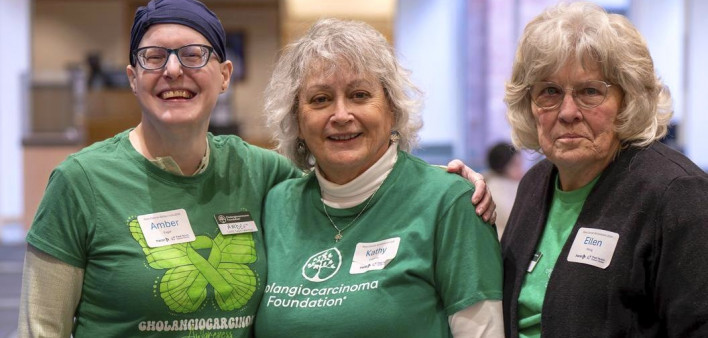
“I got my diagnosis in the ER in November 2021,” said Kathy Virgallito, 76, of Shoreline, Washington, who attended with other patients who volunteer for the Cholangiocarcinoma Foundation. Cholangiocarcinoma is a rare and aggressive form of bile duct cancer.
“I’d never heard of it before and couldn’t even pronounce it,” she said. “It was startling and scary and quite overwhelming and then the doctor, who was not an oncologist, came in and said ‘Cholangiocarcinoma ― that’s a terrible diagnosis!’ He told me to go home and settle my affairs and connect with hospice.”
Tone-deaf proclamations like this aren’t unusual in the rare cancer community.
“I’m not the only one who’s been told that,” said Virgallito, who has been stable ever since she finished treatment in 2022. “It’s not an uncommon reaction for patients with cholangiocarcinoma unless the medical provider is really up to date on the advances in treatment. My daughter and I almost laugh about it now because it was so inappropriate. We call him Dr. Doom.”
While the bedside manner was lacking, Virgallito did receive a prompt diagnosis, which is not the case for many. Rare cancer patients often have to slog through dozens of doctors’ appointments, scans and other tests trying to figure out what’s causing their symptoms. Diagnoses are often delayed ― for weeks, months, sometimes even years ― and some patients are misdiagnosed and/or even treated for other cancers.
Rosie Robrigado, 79, of Murrieta, California, didn’t even know she had a rare cancer until a few months ago. Originally diagnosed with what she was told was uterine cancer in 2021, she went through surgery and treatment, but then the cancer came back “with a vengeance” in 2024.
“I went through chemo, then chemo with immunotherapy, then just immunotherapy and then I had these capsules,” she said. “With every treatment I was hopeful it would be reduced, but it was still growing.”
Frustrated, she requested a second opinion, a new biopsy and the original pathology report from her 2021 surgery.
“I found out that it was uterine carcinosarcoma and the doctors did not inform me,” Robrigado said. “Nobody told me. I didn’t know the actual diagnosis until my second oncologist told me, ‘What you’ve got is the rarest of the rare.’”
Challenging for clinicians and researchers, too
Hagan, the UW immunologist, said rare cancers can be a huge challenge for many oncologists, especially community oncologists, who may have never encountered a case before.
“They might not know what to tell their patients,” she said. “They might not have any training or be able to find external experts or referrals.”
Rare cancers are notoriously understudied, she said, so there may be very little research for clinicians to go on. Not only is it challenging to gather enough patients together for a clinical trial, but pharmaceutical companies ― the entities that run most therapy clinical trials ― tend to focus on diseases that affect many patients to make it worth their while.
It’s also difficult to get funding from government sources when there are no pre-clinical models to study, another motivation for Gujral’s collaborative, multi-pronged research approach.
Robrigado, who was unable to attend the symposium, said she’s relieved to finally know her exact type of cancer, but is concerned about her earlier care and the avenues it may have closed off.
“That really is my number one disappointment,” she said. “That I didn’t know until a few months ago that it was really uterine carcinosarcoma. I don’t think I have been getting the right treatment.”
These days, the former aerospace global quality manager is trying to find a clinical trial.
“I called the National Cancer Institute, and they found a clinical trial at UC Irvine,” she said. “I shared the information with my new oncologist, and she was excited about it, but then she found out I didn’t qualify because I’d been through some treatments already. I’m reviewing other clinical trials, but they have exclusions so I may not qualify.”
Currently on another line of chemo, Robrigado said she feels as if her doctors are learning about uterine carcinosarcoma at the same time she is.
“I don’t think they have another patient like me,” she said. “How special I am!”
Rare cancer realities
Virgallito, the cholangiocarcinoma patient, said she appreciated the scientific information presented at the symposium, as well as the practical advice for dealing with the realities of rare cancer life.
“As one of the last panelists mentioned, there’s such value in connecting with rare cancer advocacy organizations as a way to stay informed and feel less isolated,” she said. “And the discussion about the emotional and practical realities of living with rare cancer was very meaningful, especially the examples of how to respond to peoples’ questions that often feel invasive.”
She’s also happy to know scientists here in the Pacific Northwest are studying her disease.
“It’s reassuring knowing there are researchers at Fred Hutch working on this,” she said. “It’s exciting to know that this research is going on right here where I live. It increases my hope.”
Most of all, she said she appreciated the opportunity to meet and mingle with other rare cancer patients and hopes to have a chance to do so again.
“There’s a special connection when you meet someone else with a rare cancer,” she said. “How many times do you get a chance to meet someone who knows exactly what it’s like to have a cancer that nobody understands?”
SIDEBARS:
Watch the 2026 Rare Cancer Patient & Caregivers Symposium!
Rare cancer resources
Fibrolamellar Cancer Foundation
National Leiomysosarcoma Foundation
National Organization for Rare Disorders
Rare Cancer Research Foundation
Diane Mapes is a senior editor and writer at Fred Hutch Cancer Center, who’s written for NBC News, TODAY, CNN, MSN, Seattle Magazine and other publications. A breast cancer survivor and patient advocate, you can reach her at dmapes@fredhutch.org or doublewhammied.com / @double_whammied / @doublewhammied.bsky.social. Just diagnosed and need information and resources? Visit Fred Hutch’s Patient Care page.
This article was originally published March 5, 2026, by Fred Hutch News Service. It is republished with permission.

Comments
Comments