

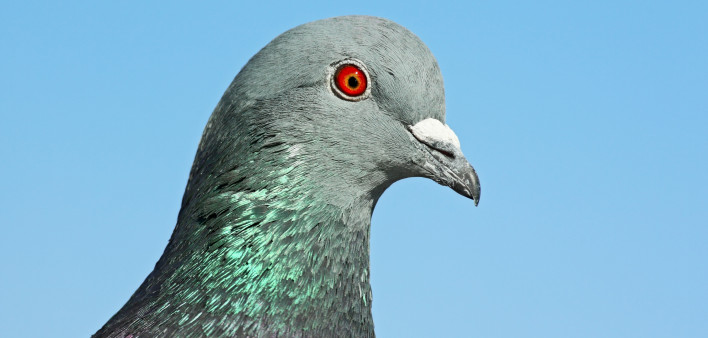
Early detection and treatment of cancer improve patient outcomes, but when radiologists review scans, they miss abnormal growths, or nodules, about 30% of the time. To improve these odds, cognitive neuroscience researcher Gregory DiGirolamo, PhD, has trained pigeons to detect lung nodules on chest scans, reports Popular Science.
You read that correctly: Pigeons. The birds are unusually good at the task, and DiGiorlamo is studying their process with the intention of turning the findings into a powerful medical AI tool that can help identify lung cancer in earlier stages, when it’s easier to treat.
Excluding skin cancer, lung cancer is the second most common cancer for both men and women (second to prostate cancer in men and breast cancer in women) and is by far the leading cause of cancer death in the United States. The American Cancer Society estimates that this year alone will see 229,410 new cases of lung cancer and 124,990 deaths from the disease.
A chest X-ray is often the first test performed on a person with symptoms of lung cancer, but computed tomography (CT) scans are recommended for adults who have a history of smoking. If a mass is found, a biopsy may be required to determine if the growth is cancerous.
To learn more about lung cancer detection and diagnosis, read Cancer Health’s Basics on Lung Cancer.
Radiologists miss an average of three out of every ten scans with an abnormal growth. Diving deeper into this issue, DiGirolamo found that when radiologists miss a nodule on a lung scan, their non-conscious brain still picks it up. Eye tracking technology showed that a radiologist’s eyes linger and pupils dilate when they look at the nodule. He published the results of that research in Radiology last year.
Building on that knowledge, researchers also looked at the ways pigeons read imaging scans and how new technology succeeds at the task. “Artificial Intelligence has made significant progress in aiding radiologists’ evaluation of images; however, these computerized systems also make errors, sometimes missing an abnormality but more often misidentifying healthy cases,” wrote the authors of a study published this year in Animal Cognition.
Why pigeons? A pigeon’s brain works a lot like the unconscious part of a human’s vision, so research using pigeons can tell us a lot about what goes on when radiologists miss nodules. For the Animal Cognition study, DiGirolamo and his team trained six pigeons to detect lung nodules on videos of chest CT scans.
Pigeons were showed 12 scans, half with clear lungs and half with a solid lung nodule. Three of the pigeons were rewarded for identifying clean scans, and the other three were rewarded for identifying abnormal scans. The pigeons learned to correctly read the scans and went on to use their new knowledge on brand new scans.
The findings suggest the importance of unconscious processing in analysis of medical images. Using the pigeons’ model of detection, AI algorithms could become more accurate.
DiGirolamo intends to capture radiologists’ perception of subtle abnormalities using eye gaze-tracking and physiological data to train AI models.
“DiGirolamo makes it clear that this medical AI will not replace radiologists,” writes Popular Science journalist Clarissa Brincat about the studies. Instead, the technology “will act as a tool that learns directly from their eyes, bridging the gap between their conscious and non-conscious brain, and ultimately enhancing their judgment.”



Comments
Comments