


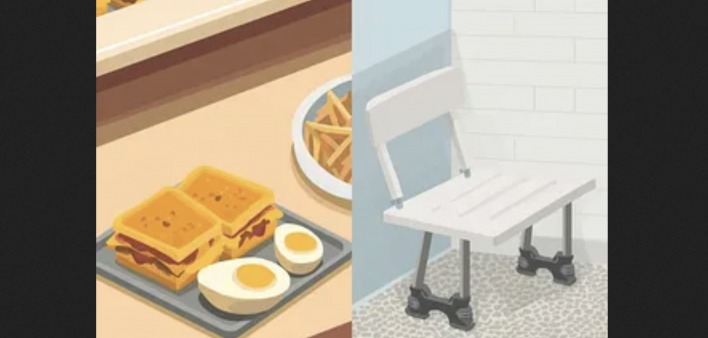
Pastrami, is there anything it can’t do?! The deli has taught me lessons recently. No fewer than three awkward experiences have occurred in the line:
There was the guy in a black-on-black Elon-style MAGA hat queued behind me. Sir, you are precisely one Roman Salute and one AfD party endorsement beyond your earned right to queue in the deli line.
Then there was me, queuing with my impaired proprioception on the left side — the sense that navigates your limbs in space, weakened from the tumor in my parietal lobe. It wasn’t until the short, gray-haired woman beside me gasped that I noticed my errant left hand had grazed her hip. She gasped. I gasped. “I thought you were my husband!” she said. Whitney rushed in, signaling either that I was harmless or a klutz — or, truthfully, both.
And then there was the cane incident. Waiting patiently for my carry-out order, I was eyeing the Doc Brown’s when someone grabbed my cane. Quite unsettling — I actually need this thing to walk! Still holding it, she lifted my arm with her other hand, drew my shoulder to my chin, and commanded, “Bend your elbow!” Then she pushed at the small of my back to straighten my posture. “There! That is how your cane should be sized! Have a good day.” Like that, my unsolicited cane fitting ended. No charge, apparently.
“Order for Adam!”
I love the deli.
The deli with brain cancer is harder than I’d like it to be.
The large cafeteria space, linoleum, metal deli bar running the length of the room, at least fifty people sliding their trays on a busy lunch — the acoustics are pretty tough on a dude with epilepsy who can get overstimulated. And teetering that cafeteria, balancing my pastrami on rye and side of coleslaw — okay, often sides, plural, of coleslaw and deviled eggs; I didn’t come to play. It’s all parve and meat, if you hold the swiss. Anyway, getting that thing to a table while I shuffle slowly with my cane hooked over an arm… It’s a miracle I haven’t yet spilled a loaded tray across the dining room.
Maybe if I’d just size the damn cane correctly!
We have a walk-in shower in the bath off our primary bedroom, and that’s a good thing because when you’ve had a second round of radiation to a previously irradiated area in your brain, it’s not only the proprioception that worsens. When that area includes the parietal lobe, which is responsible for sensory input and motor control, the impairments also affect movement. I say the walk-in shower is a good thing because I can, obviously, walk in.
The shower is treacherous territory for anyone disabled or aging. To avoid stepping over a tub wall is profoundly safer than taking a high step with impairments. Even without the deli tray.
Unfortunately, we discovered a soft spot in our bathroom floor that led to the discovery of an undetected leak in the crawl space, significant damage to the subfloor, and a mold I’d rather not think too much about. The remediation crew wore hazmat suits on at least one occasion.
The mold test guy brought his air tester over near my desk in the bedroom.
“Do you sit here often?”
“Only eight to ten hours a day, Monday through Friday.”
While the demolition continues, the walk-in shower had to go; its subfloor was soaked through. Thankfully, we’re a two-bath home. The caveat: the second bathroom is a standard tub-shower combo.
(Note: I began this post prior to learning yesterday that the second bathroom is also affected and will be demo’d, so stay tuned for our nomadic lifestyle! Don’t worry, we have a great community, and insurance is being super cool. We’ll just be put up elsewhere for a while.)
At any rate, I’ve gotta shower. My youth of punk rock and my work-from-home lifestyle buy me some leniency on frequency, but it’s hard to convince the boys to shampoo their hair if I haven’t been in there all week.
So I grasped the grab bar Whitney’s stepdad installed and timidly took the step. With my feet unsure, I clung to the very top of the shower wall, fingertips curved like a kid learning to walk by pulling up on the coffee table. I shuffled here and there under the shower head, reaching for my 14-year-old’s Axe body wash. Like that scene in Spiderman when Peter first discovers his powers, grabbing at clotheslines and windowsills on the way off a building, except Spidey gives me too much credit; more like a toddler pulling up on the furniture.
I managed to shuffle without falling, but after a couple of these showers, I knew it wasn’t sustainable. As Whitney reminds me far too often, “You know, I have a graduate degree and 20 years as an Occupational Therapist, right?” She knew just what to do.
The hospital-grade composite plastic bench features large, gray rubber feet, like an elephant’s. It straddles the tub, so I can sit on the outside and slowly scooch myself across the tub wall into the shower. No feats of strength. No feats of balance. (When I typed “feats,” I knew “of strength” was coming next.)
Assistive devices are tough for disabled people to embrace, and I’m sure I’ve made this point before. They feel limiting until… until you realize they, in fact, create independence by expanding the diameter of safe movement. Whitney would prefer I use my walker at all times, even in the house — and she’s right. I’ve taken some hard falls recently, and with low platelets, I’m bruised and banged up. I’m still working on embracing the tools. But it feels good to shower without fear of broken bones or head injury.
We say in the disability justice world that disability isn’t inherent to the individual; it happens, disability occurs, when our surroundings are not universally designed. As stubborn as I am, and as quick as Whitney would be to call bullshit if I told you I used my walker regularly, having a little more control in my bathing is an accomplishment.
Like when one of the kids washes their hair.
What do you need a little nudge to do, despite your ego? I give you permission to approach the bench.
This blog post was published by Glioblastology on October 2, 2025. It is republished with permission.



Comments
Comments